Key Takeaways
- Traffic without leads is almost always a strategy problem, not a traffic problem.
- Most websites lose leads in five predictable places: intent mismatch, a weak value proposition, no real marketing funnel, a thin trust stack, and a lack of real diagnostic data.
- Fixing one of these levers compounds your results far faster than chasing more visitors.

You’re getting visitors. Your analytics may have taken a bit of a hit since AI is stealing some of your traffic. Your inbox is quieter than usual, and your calendar has more holes than Swiss cheese!
Here’s what most people get wrong. They assume the answer is more traffic, more ads, more referrals. Sometimes it is. But the bigger issue is almost always strategic rather than tactical.
A small tweak to a button color won’t save a website that doesn’t know who it’s talking to. A faster page load won’t fix a brand that visitors don’t trust.
In this post, I’ll walk you through the four strategic fixes I see driving the biggest results across service businesses, online businesses, and personal brands.
Why does this matter so much? Because a 1% lift on a website with 5,000 monthly visitors can be the difference between a slow month and your best quarter.
Let’s get into the 5 fixes…
What You’ll Discover
- Why Traffic Without Leads Is a Strategy Problem, Not a Traffic Problem
- How to Match Your Page to Visitor Intent (Cold, Warm, and Hot)
- How to Sharpen Your Value Proposition So Visitors Get It in 5 Seconds
- Why “Selling on Hello” Costs You 97% of Your Leads
- How to Build a Trust Stack That Earns Confidence in Seconds
- How to Use Real Data to Find What’s Actually Broken
- A Real-World Case Study: GRIT BXNG New York
- The Decision Framework: Which Fix to Tackle First
Fix #1: Match Your Page to Visitor Intent
The single biggest reason your website has traffic but no leads is that it treats every visitor the same way.
Most visitors fall into one of three buckets. Cold leads have never heard of you. Warm leads have engaged with some of your content but aren’t ready to buy. Hot leads already trust you and just want a frictionless path to take action. Here’s a blog about the principles that explains the most common website conversion problems.
If your home page is built only for hot leads, you’ll lose 80 to 90% of your traffic. If it’s built only for cold leads, you’ll annoy your hot leads with too many trust-building hurdles before they can buy. The fix is to design your website as a traffic director, not a closer.
What this looks like in practice
- A clear primary CTA above the fold for hot leads who already know what they want
- A free, valuable lead magnet for cold leads who need education first
- Trust-building content like case studies, video testimonials, and credibility markers for warm leads who need reassurance
- Dedicated landing pages for each offer, so paid traffic lands on something specific to their search intent, not your generic home page
One of the biggest mistakes I see is sending paid ad traffic directly to a home page. Cold ad traffic needs a focused landing page that speaks to the exact problem they searched for, with the trust elements stacked in the right order, and no top navigation pulling them away.
Quick test
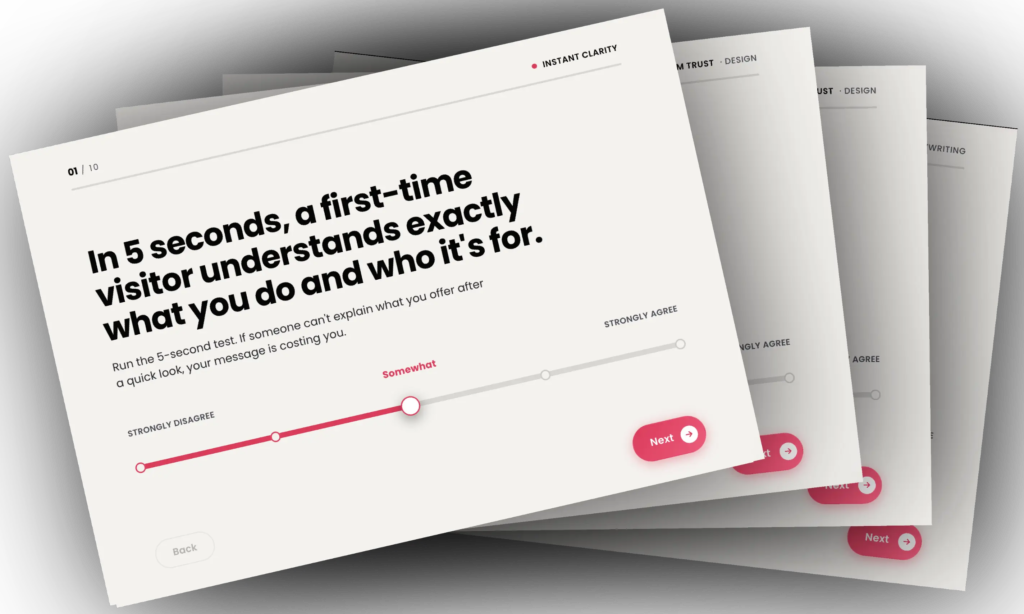
Open your home page and ask: can a visitor identify within five seconds what you do, who you help, and where to go next based on their level of awareness? If the answer is no, you’ve found Fix #1.
Fix #2: Sharpen Your Value Proposition
People decide whether to stay on your website in seconds. If your headline is generic, your value proposition is fuzzy, or your offer is unclear, they leave. Even if your service is genuinely better than your competitors’.
Your visitors are silently asking three questions the moment they land:
- What do you do?
- Who do you help?
- Why should I trust you?
If your home page can’t answer all three within seconds, your value proposition needs work. A weak headline like “Helping businesses grow” is forgettable. A specific, benefit-driven headline is memorable, and more importantly, it qualifies the right visitors and disqualifies the wrong ones.
What a strong value proposition does
- Names the specific outcome you deliver, not the activity you perform
- Speaks directly to the pain point your ideal client is feeling right now
- Differentiates you from competitors using your “Only Factor”, the thing only you can credibly claim
- Pairs with a compelling subheadline that handles the obvious objection
Think about an industry where every competitor looks identical: personal injury law, financial advisors, and dental practices. Most of these websites lead with “Welcome to our firm” or “About us,” paired with a stock image and a generic “Contact Us” button. The result? Visitors can’t tell one from the next, so they default to the cheapest option, or worse, the most familiar brand name they’ve already seen on a billboard.
The businesses that win in those industries do the opposite. They rebuild their positioning around the client as the hero of the story. They replace the generic “Contact Us” button with something benefit-driven like “Get A Free Case Evaluation.” They lead with real client success stories instead of credentials. That single shift in messaging changes how prospects perceive the business before they ever pick up the phone.
Quick test
Cover your logo with your hand and read your home page headline. Could it belong to any of your three closest competitors? If yes, your value proposition needs sharpening.
Fix #3: Stop “Selling on Hello” and Build a Real Marketing Funnel
Here’s a hard truth most websites get wrong. The vast majority of your visitors aren’t ready to buy on their first visit. They don’t know you. They don’t trust you yet. And they’re not going to fill out a “Contact Us” form on day one.
Yet most websites only offer two options: buy now or book a call. There’s no middle path. Cold visitors who aren’t ready to commit leave without giving you their email, and you have no way to bring them back.
I call this “selling on hello.” It rarely works.
Think about it like a physical store. You walk in to browse, and a salesperson immediately shoves a product in your hand demanding a decision. You’d feel pressured, confused, and you’d leave. That’s exactly what most websites do to first-time visitors.
The fix is to build a real marketing funnel with multiple pathways for visitors at every stage of awareness.
What a complete marketing funnel looks like
- For cold leads (the majority of your traffic): Offer a high-value lead magnet such as a guide, checklist, free assessment, or mini-course in exchange for their email. This captures the visitor instead of losing them.
- For warm leads: Offer case studies, video training, podcast episodes, or webinars that build trust without asking for the sale.
- For hot leads: Give a frictionless path to book a call, buy, or sign up.
- Behind the scenes: An email nurture sequence brings leads back to your site over weeks or months, gradually moving them from cold to warm to hot.
This is the difference between a website that converts 2% and a website that converts 8 to 10%. The visitors who weren’t ready on day one come back when they are, because you stayed top of mind.
It’s also where most strategy advice falls down. Building a real funnel means thinking about your business as a system, not a website. Where does cold traffic come from? What’s the right next step for each visitor type? How do you bring them back? Most websites don’t have answers to those questions, which is why they leak leads at every stage. Here’s a blog on how to avoid costly website leakage mistakes.
Quick test
If a visitor lands on your website today and isn’t ready to buy, what’s their next move? If the answer is “leave,” you don’t have a marketing funnel. You have a digital brochure.
Fix #4: Build a Trust Stack That Earns Confidence in Seconds
Trust isn’t a nice-to-have. It’s the foundation every other fix sits on. You can have perfect intent matching, a brilliant value proposition, and a working funnel, but if your website doesn’t feel trustworthy in the first few seconds, none of it matters.
Visitors decide whether to trust you fast. Subconsciously, they’re scanning for cues that say “this business is real, established, credible, and worth my time.” If those cues are missing, they bounce. Even if your service is the best option for them.
This is where strategy and brand positioning collide. A trust stack isn’t just a few testimonials sprinkled on a page. It’s a deliberate, layered system of credibility signals that work together to make the choice obvious.
What a strong trust stack includes
- Visual quality that matches your price point. A premium service with a generic-template look loses the sale silently. Custom design, professional imagery, and consistent branding tell visitors you’re a serious operator.
- Real social proof, prominently placed. Video testimonials beat written ones. Specific results beat vague praise. Place testimonials at decision points throughout the page, not just on a “Testimonials” page nobody visits.
- Authority markers. Press logos, podcast features, awards, certifications, books authored, speaking engagements. Anything that signals you’re recognized in your industry.
- Case studies with measurable results. Before-and-after stories with real numbers are some of the most persuasive content on the web.
- Risk reversal. Guarantees, free trials, money-back promises. Anything that says “you can’t lose by choosing us.”
- Real photos of real people. Your team, your work, your space, your clients. Stock photos of generic professionals in suits actively erode trust.
The trust stack is also where most service businesses, personal brands, and online businesses underinvest. They focus on copy and forget that visitors are reading the design just as much as the words. A polished, distinctive, premium-feeling brand silently does more selling than any headline you’ll write. Here’s how to boost your website performance by building trust.
Quick test
If a visitor landed on your website right now with no context, would they believe you’re a credible expert in your field within seven seconds? If not, Fix #4 is your biggest opportunity.
Fix #5: Use Real Data to Find What’s Actually Broken
You can’t fix what you can’t see. And most websites that aren’t converting are running blind.
Here’s what I see again and again. A business owner senses something is wrong with their website, so they redesign the home page, swap the headline, change a button color, and then wait. The leads still don’t come. Why? Because they fixed something based on a guess, not a measurement.
The strategic move is to install proper diagnostic tools before you change anything. Microsoft Clarity, Google Analytics, and a simple session recording tool will tell you in 48 hours exactly where your visitors are dropping off and which of the previous four fixes is actually your biggest leak.
This is the difference between two businesses that look identical from the outside. One is making changes based on opinion. The other is making changes based on what real visitors are actually doing on the page. The second one wins, every time.
What “use real data” looks like in practice
- Heatmaps show you where visitors are clicking, scrolling, and ignoring on each page.
- Session recordings let you watch real users navigate your site, including where they get confused or frustrated.
- Funnel analytics show you the exact step where visitors are leaving.
- Form analytics show you which form fields cause the most drop-offs.
- Page-level conversion tracking tells you which pages do the heavy lifting and which are silently leaking leads.
Microsoft Clarity is free, takes about ten minutes to install, and will show you more about your visitors in a week than years of guessing ever will.
The other strategic shift is to treat your website as a living asset, not a one-time project. The websites that consistently outperform their competition aren’t the ones that launched the prettiest. They’re the ones that get refined month after month based on what the data is telling them. Here are diagnostic tools that reveal your website’s problems.
Quick test
If someone asked you tomorrow which page on your site has the highest bounce rate, would you know the answer? If not, Fix #5 is the foundation you need to put in place before any of the other four fixes will compound properly.
Case Study: GRIT BXNG New York
Bill Zanker had built something special. GRIT BXNG is a premium boxing-style fitness studio in New York, backed by some of the most recognizable names in business and entertainment, including Pitbull and Tony Robbins as investors. The brand had heat, the concept was strong, and the studio was driving real traffic to its landing page.
The problem? That traffic wasn’t converting. As Bill put it when we first connected, the landing page wasn’t delivering the conversions they needed. They were getting a trickle of sales, not the flood the brand should have been generating.
The Problem
The original landing page had every classic issue we’ve covered. The value proposition didn’t immediately communicate what made GRIT BXNG different from every other premium fitness studio in New York. There was no clear funnel logic, the page tried to do too much for too many visitor types at once. The trust stack was thin given the caliber of investors backing the brand, and visitors landing from paid ads had no obvious next step that matched their level of intent.
In short: a fuzzy value proposition, no strategic funnel for paid traffic, and a trust stack that didn’t reflect the premium nature of the offer.
What Changed
We redesigned the landing page from a conversion-focused angle, applying the same four strategic principles outlined in this post.
For visitor intent, we treated the landing page like a landing page. No top navigation pulling visitors away. One clear path forward. The page spoke directly to the paid traffic source it was receiving, not a generic mixed audience.
For value proposition, we sharpened the messaging around what GRIT BXNG actually delivers, a high-intensity, music-driven boxing experience unlike anything else in the New York fitness market.
For marketing funnel, we structured the page to give visitors a single, focused conversion goal with trust-building elements stacked in the right order before the ask.
For trust stack, the copywriter created compelling new content and built credibility signals throughout the page that finally matched the caliber of the brand and its backers.
Use Real Data to Find What’s Actually Broken
For using real data, we focused on real user behavior and conversion data to identify where visitors were dropping off, which allowed us to redesign the page around how people actually interacted with it.
The Outcome
The results were dramatic. After the redesigned landing page went live, GRIT BXNG went from a trickle of sales to over 1,000 sales in the first month alone.
Same traffic. Same offer. Same market. A landing page that finally did its job.
The story is a powerful reminder of how much performance is sitting on the table when a website or landing page isn’t strategically built. Bill was impressed enough with the results that he later introduced us to Sylvester Stallone, who then became a client, but that’s a story for another post.

The Decision Framework: Which Fix to Tackle First
You don’t need to fix all five at once. Start with whichever has the biggest visible gap on your website right now.
- If your home page can’t tell a stranger what you do in 5 seconds, start with Fix #1 (Visitor Intent).
- If your headline could belong to any of your competitors, start with Fix #2 (Value Proposition).
- If “buy now” or “book a call” are the only ways to engage on your site, start with Fix #3 (Marketing Funnel).
- If your website looks like a template and lacks social proof, start with Fix #4 (Trust Stack).
- If you have no idea where visitors actually drop off on your site, start with Fix #5 (Real Data). You can’t fix the others properly without it.
Most businesses have at least two of these issues simultaneously, which is why the compounding effect is so powerful. Address them one by one and the results stack up fast.
Frequently Asked Questions
Why is my website getting traffic but not converting?
Almost always, it’s a strategy problem rather than a traffic problem. The five most common root causes are: your page doesn’t match visitor intent, your value proposition is too vague, you have no real marketing funnel for cold visitors, your trust stack is too thin, and you don’t have the data to know which of these is hurting you most. Most websites have at least two of these issues, which compounds the problem.
How long does it take to see results from these fixes?
Some changes show results within days. Sharpening a headline or adding a lead magnet for cold traffic can move conversion rates within the first week. Larger changes like restructuring your funnel or repositioning your brand typically need 30 to 90 days of data to evaluate properly. The key is to test one change at a time so you actually know what worked.
Should I redesign my whole website or just optimize what I have?
It depends on where you’re starting. If your existing website has solid foundations (clear positioning, decent design, working funnel), targeted optimization is usually the smarter path. If your site has fundamental issues with brand positioning, page structure, or visual quality that signal “untrustworthy” to a first-time visitor, optimization alone won’t save it. A free audit is the fastest way to know which path makes sense for you.
What’s a good website conversion rate in 2026?
It varies by industry, traffic source, and page type. Unbounce’s 2026 benchmark data places the median landing page conversion rate at 6.6%, with the top quartile clearing 10%. For service businesses, a well-optimized book-a-call page often converts above 8%. If you’re below 4%, there’s almost certainly a quick win available in the five fixes above.
I don’t have a lead magnet. Where do I start?
Start by listing the top three questions your ideal clients ask before buying. Your lead magnet should answer one of them in a way that’s genuinely useful. It could be a checklist, a short guide, a video training, or a free assessment. The format matters less than the value. The goal is to capture cold traffic that isn’t ready to buy yet, so you can build a relationship over time.
Conclusion: Your Traffic Is Already There. Your Leads Are Hiding.
Here’s the truth most marketers won’t tell you. You don’t need more traffic. You need more of the traffic you already have to take action.
The five strategic fixes we covered (matching visitor intent, sharpening your value proposition, building a real marketing funnel, stacking visible trust, and using real data to find what’s actually broken) are the highest-leverage changes I see drive results across every type of business. Address them systematically and your website stops being a digital brochure and starts being your hardest-working salesperson.
If you’d like a second pair of eyes on your site to identify exactly where your leads are leaking, I’d love to help.
Book a free Strategic AI Audit & Call with our team and we’ll show you the 20% of fixes that will unlock 80% of your conversion upside. Schedule a free call here.
And if you’d like to go deeper, you can grab a copy of my book Next Level Website Design, which expands every principle in this post into a full step-by-step playbook.