Key Takeaways
- Every brand runs on eight forces: Beliefs, Reputation, Authority, Narrative, Differentiation, Identity, Niche and Growth.
- Each one is a trust signal, and trust is what turns cold visitors into paying clients.
- You don’t need to fix all eight. Tightening two or three is usually enough for a real lift.

Introduction
I ask almost every founder who calls Studio1 the same question: if a cold visitor landed on your website right now, would they trust you enough to buy in the next five minutes?
Most of the time, the honest answer is no. It’s rarely because the product isn’t good. It’s because the brand behind the website hasn’t done its job yet.
After designing more than 2,000 websites and brands for entrepreneurs and household names like Sylvester Stallone, Frank Oz and Jordan Harbinger, I keep seeing the same pattern. Businesses that convert consistently and grow without chasing endless traffic all have one thing in common: a brand doing real psychological work in the background.
That work breaks down into eight forces. I call it the BRANDING framework: Beliefs, Reputation, Authority, Narrative, Differentiation, Identity, Niche and Growth.
Get these right and your website stops being a digital brochure and becomes a 24/7 sales asset. In this article, I’ll walk you through each letter and show you what it looks like when it’s working, with real client examples along the way.
The BRANDING framework
B – Beliefs
R – Reputation
A – Authority
N – Narrative
D – Differentiation
I – Identity
N – Niche
G – Growth
B – Beliefs
Every brand that resonates is built on a clear set of beliefs, the “why” behind the business, before you ever get to the “what” or “how.”
People don’t just buy products anymore. They buy into the values and worldview behind them. When your beliefs are clear on your website, they act as a filter.
The right visitors lean in, and the wrong ones self-select out early, saving everyone a wasted sales call.
Most businesses never actually say what they believe. Their home page lists services and features, but never answers the quiet question every visitor is asking: what does this company actually stand for? That disconnect creates friction, and friction kills conversions.
A few quick wins:
- Write your beliefs down in one sentence before writing any website copy.
- Weave them into your About page, not just a mission statement nobody reads.
- Show your beliefs in action through case studies, causes you support, or standards you won’t compromise on.
This is why we start every branding project at Studio1 with a strategy session, not a design brief. We need to understand what you believe before we can design something that makes visitors believe in you too.
For a deeper look at why this matters for conversions, read Why Branding Matters.
R – Reputation
Reputation is what other people say about you when you’re not in the room. Online, it’s almost entirely what your website says about you before they ever reach out or contact you.
This is social proof at work. People look at what others have done before making a risky or expensive decision themselves.
A visitor who sees strong reputation signals, like testimonials, logos, case studies and media mentions, resolves their doubt faster. They move toward a decision instead of bouncing off to “think about it.”
We saw this with podcast host Jordan Harbinger. His old website didn’t reflect his show’s scale, millions of monthly downloads and an Apple “Best Podcast” nod, so visitors underestimated him on arrival.
After we redesigned the site to properly showcase those numbers, marketers started using it as their reference for what a “gold standard” podcast website should look like.
If your results, testimonials and credibility markers are buried below the fold, or missing altogether, you’re leaving trust on the table. For more on turning trust into conversions, read How to Boost Your Website Performance By Building Trust and Relationships.
A – Authority
Authority is reputation’s more assertive cousin. Reputation says people trust me. Authority says I’m the expert you should be listening to.
Authority comes from credentials, media features, speaking engagements and follower counts, but mostly from how clearly you present them.
I’ve watched founders with impressive backgrounds get overlooked because their website buried the proof. I’ve also watched newer businesses punch above their weight simply by presenting what they had with confidence.
The fix is rarely “go get more credentials.” It’s almost always “design what you already have so it lands.” I call this an impact metrics authority strip: your strongest numbers, features and recognizable client logos, grouped together near the top of the page instead of scattered or buried.
A well-placed “as featured in” bar or a founder photo that looks like an expert rather than a stock image does the same heavy lifting.
This is also the thinking behind our Authority Growth Engine approach, using design, positioning and content strategy together to compound your authority instead of chasing it one campaign at a time.
N – Narrative
Every brand tells a story, whether it means to or not. The question is whether that story is intentional, or an accident of whatever got added to the home page over the years.
Narrative connects your origin, your why, your process and your results into something a visitor can follow and remember. Facts alone don’t convert as well as facts wrapped in a story, because stories are how people actually process and retain information.
A well-structured narrative also guides a visitor’s eyes and emotions through your page in the order that builds toward a yes.
Look at how your home page flows right now. Does it open with a pain point the visitor recognizes, walk them through how you solve it, and land on proof it worked for someone like them? Or does it just list what you do?
That structural difference is often what separates a visitor who reads for ten seconds from one who reads for ten minutes. We go deeper on page-level storytelling in The Psychology of the Home Page Hero.
D – Differentiation
If a visitor can’t tell you apart from two competitors in the next tab, price becomes the only thing left to compete on. That’s a race to the bottom nobody wins.
Differentiation isn’t about being louder or flashier. It’s about being clear on the one or two things that make you genuinely different, then designing your whole brand to reinforce that difference at every touchpoint.
I’d rather have a client be crystal clear about one real point of difference than vaguely “unique” across ten.
A quick self-test: if you removed your logo from your home page, could a visitor still tell it was you? If not, you likely look like everyone else in your space, whether you meant to or not.
We wrote about this exact trap in Clear vs Clever: Why Clarity Wins Every Time!, a lesson that applies just as much to your positioning as it does to your copywriting.
I – Identity
Identity is where your beliefs, reputation, authority, narrative and differentiation become visible: your logo, color palette, typography, imagery style and the consistent feel that ties every touchpoint together. I call that consistent feel the VIBE of your brand.
The psychology is simple: consistency builds trust, and inconsistency quietly erodes it. When your Instagram looks nothing like your website, and your website looks nothing like your proposal deck, visitors register that mismatch as a small red flag, even if they can’t say why.
Multiply that across every touchpoint and you’ve built friction into your funnel without realizing it.
A strong identity system does the opposite. It makes your brand instantly recognizable, and makes every new piece of content faster to create because the framework already exists.
This is exactly the problem our Brand Blueprint package is built to solve: mood board and brand direction, logo design, color palette, fonts, brand elements and a full style guide, so every touchpoint looks like it belongs to the same company.
If you want the fundamentals first, start with How to Create a Powerful Brand Identity and How to Create a Brand Style Guide.
N – Niche
Of all eight letters, this is the one founders resist most, and the one that tends to move the needle fastest once they commit to it.
There’s a fear that narrowing your niche means turning away business. In practice, the opposite happens.
A visitor who sees a brand speaking directly to their exact situation trusts it more than one that says “we help all kinds of businesses,” even if the second one could technically do the same work. Specificity reads as expertise. Vagueness reads as inexperience.
We saw this with mypilatestime.com. Rather than positioning as one more generic online Pilates library competing against endless free workout videos, the brand was built for a very specific person: women who want gentle, sustainable movement, not punishing workouts.
Every page speaks directly to someone rebuilding strength and mobility for real life, not chasing a fitness aesthetic. That specificity is what makes a visitor feel like the brand was built just for them, not for everyone.
A tightly niched brand lets every headline, testimonial and case study speak directly to the exact person you want calling you.
If you’re weighing whether to niche down, How to Position a Service Business To Charge More walks through the pricing upside. 7 Personal Brand Website Mistakes To Avoid covers the most common ways personal brands blur their positioning by accident.
G – Growth
Growth is the letter every founder actually cares about. It’s also the one that depends almost entirely on getting the first seven right.
I see the same compounding effect again and again. Strong beliefs attract the right people. Reputation and authority lower their guard. Narrative and differentiation help them understand why you’re the right choice.
A consistent identity makes you memorable. A clear niche keeps your marketing sharp instead of soft over time. Put those together and growth stops being something you chase with ad spend, and starts being something your brand generates on its own.
Enterprise Fitness is a good example. Their brand and reputation were already strong; the missing piece was a website that reflected it.
Once we redesigned it around clearer positioning and stronger trust signals, they saw a 64% boost in consultation bookings and a 183% boost in mobile conversions, without changing their offer or ad spend. The brand did the extra work.
You can see dozens more results like this on our client results page, real businesses, real numbers, all built on the same eight-letter foundation.
FAQs
Do I need a full rebrand, or just a new logo?
Almost never just a logo. A logo is one piece of Identity, but if your other seven forces aren’t aligned behind it, a new logo alone won’t move conversions. Start with a strategy session to work out which letters actually need attention.
How long does it take to build a proper brand identity?
For a full Brand Blueprint (mood board, logo, color palette, fonts, brand elements and style guide), most Studio1 clients are through the process in weeks, not months. A structured discovery process and unlimited revisions are built into the timeline, not bolted on afterward.
Isn’t niching down going to shrink my market?
It narrows your messaging, not your market. You can still serve a broad range of clients; you just stop trying to say everything to everyone on the home page. Niche positioning consistently outperforms generic positioning in the conversion data we see.
Can I improve reputation and authority without a full website redesign?
Sometimes. Restructuring your home page to surface existing testimonials, results and credentials can produce a quick win.
But if your current design actively works against those trust signals, like a poor layout or dated visuals, the redesign is usually what unlocks the bigger lift.
What’s actually included in Studio1’s Brand Blueprint?
The Brand Blueprint covers mood board and brand direction, logo design and usage rules, a full color palette, font selection, custom brand elements and icons, treated imagery, and social banner designs. Everything you need for a consistent identity across every touchpoint.
Conclusion & Next Steps
A brand that converts isn’t luck, and it isn’t just good taste in colors and fonts. It’s eight forces working together: Beliefs, Reputation, Authority, Narrative, Differentiation, Identity, Niche and Growth. Each one removes a little more friction between a cold visitor and a “yes.”
You don’t need to overhaul all eight at once. Most businesses we work with get a fast, visible lift by tightening just two or three, often Reputation, Identity and Niche first, since they’re the fastest to fix and easiest for visitors to notice.
If you’re ready to see exactly where your brand is losing trust, and what it would take to fix it, that’s precisely what our Brand Blueprint is built for.
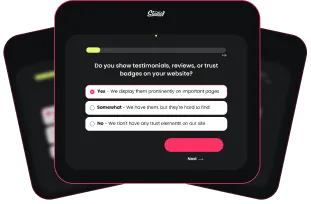
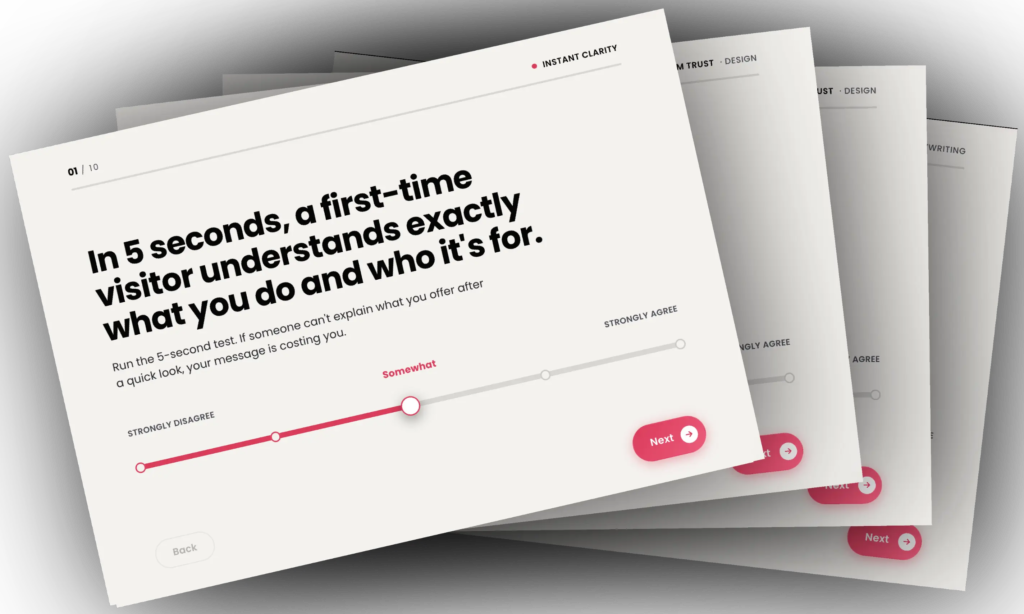
If you’re not ready for a full brand overhaul yet, start with our free interactive brand-review tool to find out which of the eight forces are the actual weak points on your own site.
Explore the Brand Blueprint offer or start a branding enquiry and we’ll walk you through it.