Key Takeaways
- How to choose between a redesign and optimizing your website
- How redesign and optimization solve different problems
- How the right choice usually comes down to whether your structural fundamentals
- How optimization can compound small wins into significant gains
- How both approaches work best as part of a connected system, not as a one-time fix
The expensive website mistake
Deciding whether you need a new website is a big decision to make.
You may have spent tens of thousands on your current website, but maybe it’s not getting results, and maybe your results are diminishing over time. That is quite normal for most websites, so you’re probably thinking that you need a totally new website, but maybe you don’t.
There’s a good chance that if your website was designed in the last three to four years, and it’s driving some leads in sales, then It may just need to be optimized instead.
We had a Service Business client (not disclosed) come to us recently who spent over $50,000 on their website. One year later, they reached out to us because it wasn’t getting them great results. We: the design wasn’t terrible. The design looked good, but it was missing a few fundamentals, including no strategy for visitors based on their intent. They didn’t have lead magnets or a pathway for people ready to buy. They simply had a contact us form.
I felt for the client after investing so much in their website. I didn’t want to sell them a new website because, frankly, they didn’t need it, so we went to work on optimizing their website instead. Some things we changed were:
- We flipped the copywriting to make the business the guide, not the hero
- We added a lead magnet and funnel steps
- We removed unnecessary clutter from the home page and service pages
- We fixed their navigation
- We added more social proof and case studies
- We added a phone number
- We fixed their mobile navigation
- We added authority boosting impact metrics
We split-tested various ideas. We implemented others that we knew were best practices. After four months, they saw a 40% spike in inquiries, and they added 150 people to their email list.
After designing and transforming over 2,000 websites, we’ve seen redesigns that should have been optimization sprints instead. We’ve also seen optimization budgets that could have funded a full redesign and build.
The wrong call can waste money, but more importantly, it can waste time, which means you’re leaving leads and sales on the table that are going to your competitors
In this article, we’ll walk through how to tell which path your website actually needs with a practical way to think about it.
What You’ll Learn
- The Real Difference Between Redesign and Optimization
- Signs Your Website Needs a Redesign
- Signs Optimization Is the Right Move
- The Middle Ground: When Both Are Needed
- A Simple Decision Framework
- Real-World Example (above)
The Real Difference Between Redesign and Optimization
These two terms get used interchangeably. They shouldn’t be.
A redesign is a structural rebuild. You’re starting from the foundation: positioning, messaging, brand identity, page architecture, and the conversion-focused design that ties them together. The output is a different website. New structure, new visual system, new pathways for visitors.
Optimization is what happens on top of a working foundation. You’re testing headlines, refining forms, adjusting CTAs, improving load times, and measuring what changes. The output is the same website, performing better than it did last quarter.
A useful way to think about it: redesign is renovating the house. Optimization is rearranging the furniture. Both improve how the place feels and functions, but they solve different problems and cost different amounts of effort.
Most business owners get this wrong in one of two directions. Some default to a full redesign every time the website frustrates them. Others try to optimize their way out of structural problems that no amount of A/B testing can fix. Knowing who you’re dealing with saves a lot of pain.
Signs Your Website Needs a Redesign
A redesign is the right call when the foundation itself is the problem. If you recognize several of these patterns, optimization probably won’t get you where you want to go.
The website looks visibly dated, and it’s hurting confidence. You hesitate to send people there. You don’t want to point a prospect to your home page during a sales call. The website is creating drag in conversations that should be moving forward.
The brand has grown, but the website still speaks from an earlier chapter. Your business is bigger, more sophisticated, or differently positioned than when the website was built. The gap between what you do now and what the website says you do is widening.
Mobile experience is poor, and most of your traffic is mobile. Pages render awkwardly on phones. Forms are hard to complete. Buttons are too small or in the wrong place. When over half your visitors are on mobile, this isn’t a minor issue.
Messaging doesn’t match what the business actually does. Your visitors land, can’t quickly figure out what you sell or who it’s for, and leave. The home page features abstract language about “innovative solutions” rather than specifics.
The page structure is fragile or impossible to update. Every change risks breaking something. The architecture is so cluttered or legacy-bound that small improvements feel exhausting.
Conversion fundamentals are missing entirely. No clear value proposition. No social proof. Buried CTAs. Generic stock photos. No lead capture for the 97% of visitors who aren’t ready to buy yet.
When these patterns are present, optimization is like adjusting paint colors on a house with cracked foundations. You can run as many tests as you want. The base problem stays.
Signs Optimization Is the Right Move
Optimization is the right call when the structure works and the gains live in the details. These are some of the patterns we typically see when a website is ready for refinement rather than rebuilding.
The website looks current and professional, but conversions are softer than expected. Visitors arrive, browse, and leave without taking action. The pages aren’t broken. They’re just not pulling their weight.
Specific pages drop off. You can identify the friction points: a long form, an unclear next step, a weak headline on a key landing page. The rest of the website does its job.
Mobile design is solid, but mobile conversion lags desktop. This is often a form or checkout issue rather than a structural one. Targeted testing usually helps.
Traffic is healthy, but lead quality varies. The website attracts visitors. Some convert into great clients. Others waste your time. Refining the messaging and qualifying questions can shift the balance.
You have analytics in place and can measure changes. Heatmaps, screen recordings, goal tracking, and conversion data are running. You can spot where people drop off and form a hypothesis about why.
When these patterns describe your website, the foundation is doing its job. The work now is steady, systematic refinement. Test one thing at a time. Measure. Keep what works. Move to the next.
This is where the compound effect kicks in. A 5% improvement in conversion rate, combined with 5% improvements in traffic and average order value, can lift overall revenue by well over 15%. Multiply that across pages and quarters, and the math becomes interesting.
The Middle Ground: When Both Are Needed
Most established businesses fall here. The website isn’t beyond saving, but it’s not strong enough to optimize productively either. The honest answer is that both are needed, in sequence.
The pattern we typically see work: redesign first to fix the foundation, then run continuous optimization to compound wins on top of it.
Why this order? Because redesigns alone tend to plateau. The launch produces a lift, then performance settles. Without ongoing testing, you never find the second, third, and fourth layer of improvements that come from real visitor data. And optimization alone can’t repair a broken base. You can’t refine your way to clear positioning if the positioning was never there to start with.
When the two work together, the redesign creates a measurable foundation, and the optimization program finds the gains that only become visible after launch. That’s how a website goes from a static asset to a hardest-working one.
A Simple Decision Framework
If you want a practical way to diagnose your situation, work through these five questions honestly.
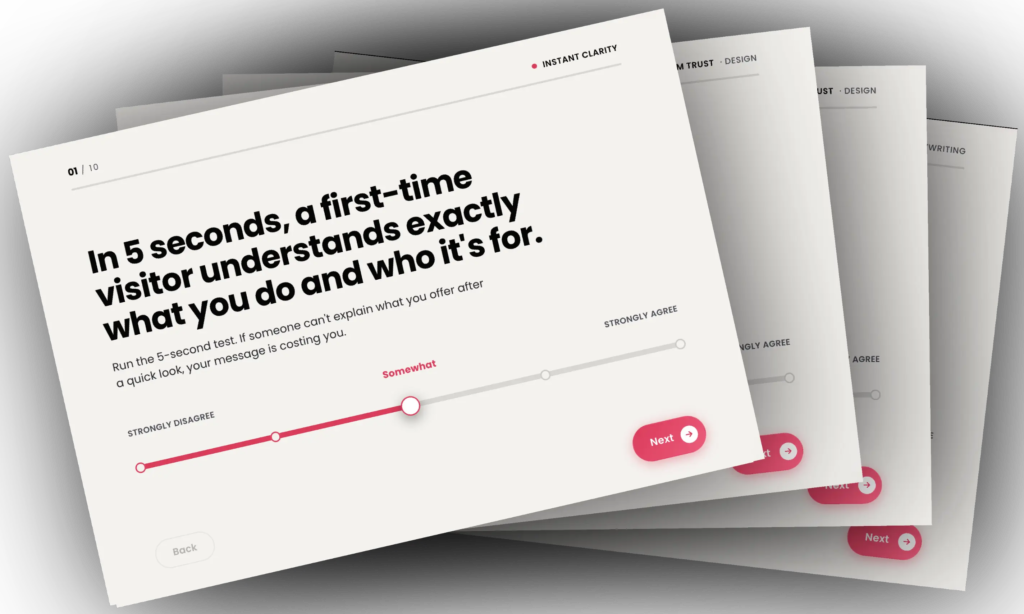
- Does your website clearly explain what you do, who it’s for, and the problem you solve, within five seconds of landing?
- Does the visual quality match the calibre of your business today?
- Is the page structure simple enough to update without breaking things?
- Do you have analytics, heatmaps, and a way to measure changes?
- Is the mobile experience solid?
How to read your answers:
- Mostly no answers: a redesign is likely the right next step. Optimization can come later, once the foundation supports it.
- Mostly yes answers: optimization is probably enough. You have what you need to test, measure, and compound improvements.
- A mixed picture: the middle path. Targeted redesign of weak pages or sections, then optimization across the rest.
This isn’t a scoring rubric. It’s a way to surface what’s actually going on, so the conversation about what to do next becomes clearer.
Frequently Asked Questions
Q: How do I know if my website needs a full redesign or just optimization?
A: Start with the five questions in the decision framework above. If your foundation (positioning, messaging, brand quality, structure, mobile) is mostly sound, optimization usually makes more sense. If multiple foundational elements are broken or outdated, optimization tools can’t fix that, and a redesign is likely the right call.
Q: Can I optimize my way out of a bad website?
A: Usually not. Optimization compounds what’s already working. It can refine headlines, forms, CTAs, and layouts. It can’t manufacture a foundation that isn’t there. If your messaging is unclear, your brand looks dated, or your page structure is fragile, testing variations of those problems won’t solve them.
Q: How long before optimization shows results?
A: Early signals can appear within weeks, but meaningful patterns typically emerge over two to three months of consistent testing. Timeline depends on traffic volume, the size of the changes being tested, and how disciplined the testing process is. Higher traffic websites can reach statistical significance faster.
Q: Should I redesign before optimizing, or can I do them together?
A: The typical sequence is redesign first to establish a strong foundation, then ongoing optimization on top of it. Doing them together is possible but harder, because you can’t isolate which changes drove which results. Most established businesses are better served thinking of optimization as an ongoing system that begins after the redesign launches, not as a separate phase.
Q: How often should a website be redesigned?
A: Most businesses benefit from a redesign every three to five years, depending on how fast their industry shifts, how much the brand has evolved, and whether the underlying technology still supports their goals. Optimization, on the other hand, is ongoing. The website that performs best over time is one that’s continuously refined between redesigns, not left static until the next rebuild.
Q: Will redesigning my website hurt my SEO?
A: Not if it’s done strategically. The risk comes from things like broken URL structures, lost page authority, missing redirects, or content that disappears in the rebuild. With careful URL mapping, preserved content, proper redirects, and SEO best practices applied throughout, a redesign can actually improve rankings rather than hurt them. The key is treating SEO as a core part of the redesign brief, not an afterthought.
Q: Where should I start if I’m not sure what my website needs?
A: A website audit is the most useful starting point. It surfaces both the quick wins (the things you can optimize now) and the structural gaps (the things a redesign would need to address). With that picture in front of you, the decision becomes clearer. If you’d like a second pair of eyes on yours, you can book a 15-minute call with us to talk it through.
Conclusion
Redesign and optimization aren’t competing options. They solve different problems at different stages of a website’s life. The key is being honest about which one your website actually needs right now, rather than defaulting to whichever feels easier or more familiar.
The websites that perform best over time are usually built on solid fundamentals, then refined continuously based on real visitor data. That combination is what turns a website from a cost center into the hardest-working asset in the business.
If you’re not sure which path is right for your situation, book a 15-minute call with us. No pitch, no pressure. Just a conversation about what makes sense for where your website is now and where you want it to go.
To your website’s success!