Key Takeaways
- AI replaced Google for your customers: Traffic dropped 30-40% because people now ask ChatGPT and Claude instead of searching. If AI doesn’t recommend you, you’re invisible.
- Educational content wins in the AI era: AI assistants recommend comprehensive, authoritative resources, not sales pitches. Fewer visitors arrive, but they’re pre-qualified and ready to convert.
- Conversion fundamentals haven’t changed: AI changes how people find you, not what makes them choose you. Clarity, social proof, and strategic messaging still drive results.


The AI Disruption: Why Your Website Traffic Is Dropping
The New Discovery Model
The old model was straightforward: problem → Google search → 10 blue links → click through websites → compare options → decide.
The new model is radically different: problem → ask AI assistant → get synthesized answer with recommendations → visit only recommended websites → arrive already educated.
Notice what’s missing? The comparison shopping. The browsing through multiple options. The discovery phase, where you had a chance to capture attention even if you weren’t the perfect fit.
In the AI-driven model, you either get recommended or you don’t exist in that buying journey at all.
How People Search Now (And What It Means for Your Content Strategy)
Traditional SEO fundamentals still matter: site speed, mobile optimization, technical structure, quality content. But the way people interact with search is evolving, and your content strategy needs to evolve with it.
Instead of searching for “business coach for entrepreneurs,” people now ask questions like:
- “What should I look for when hiring a business coach?”
- “How do I know if I need a business coach or just a course?”
- “What’s the difference between a business coach and a consultant?”
These aren’t keyword-optimized queries. They’re natural language questions. And AI assistants provide comprehensive answers by synthesizing information from multiple sources.
The game is expanding beyond ranking for specific terms. It’s also about being recognized as an authoritative source on relevant concepts. When someone asks an AI about business growth strategies, does it know you exist? When it explains scaling principles, does it reference your methodology?
What AI Assistants Actually Recommend (And How to Get Featured)
Create Comprehensive Educational Content
AI assistants favor depth over breadth. A 3,000-word article that thoroughly explains a concept will outperform ten 300-word posts.
But it can’t just be long, it needs to teach concepts, explain frameworks, and share your methodology. Your content doesn’t need to be book-length, but it does need to go deeper than your competitors.
Structure Information for AI Understanding
AI assistants rely on structure to understand content:
- Clear heading hierarchy (H2 for main sections, H3 for subsections)
- Semantic HTML that indicates meaning and structure
- Logical organization that builds progressively
- Direct answers that don’t bury the lead
Answer Questions Directly and Thoroughly
FAQ sections are more valuable than ever. Answer the actual questions your potential customers are asking AI assistants. Instead of “What services do you offer?” answer questions like “How do I know if I need a complete website redesign or just updates?”
Demonstrate Expertise Through Unique Frameworks
AI assistants recognize proprietary methodologies. At Studio1 Design, we use the SPIN Selling framework for website copy and reference the StoryBrand methodology. When we explain these frameworks in detail, we create citeable content.
What’s your unique approach? Document it thoroughly. Name it. Make it citeable.
Focus on Bottom-of-Funnel Intent
Generic keywords are increasingly less valuable. Someone asking “how do I choose a business coach who specializes in scaling service businesses” is much closer to a buying decision. Create content that addresses specific, intent-driven queries with lower search volume but higher conversion potential.
The Paradox: Less Traffic, Better Conversions
Your overall traffic numbers might be down, but many businesses are finding that their conversion rates are actually improving.
The Quality Over Quantity Shift
When someone arrives via an AI recommendation, they’ve already:
- Explained their situation to the AI
- Received context about possible solutions
- Been given a reason why your business might be a fit
- Made the decision to learn more about you specifically
They’re not browsing or comparison shopping across ten options. They’re arriving with intent and context, a “warm introduction” where the AI has essentially vouched for you.
Your job shifts from “convince them from scratch” to “confirm the recommendation they’ve already received.” This means less need for aggressive trust signals and more focus on clarity about your approach and methodology.
Content Strategy for the AI Era: What Actually Works
The 70/30 Rule: Education Over Promotion
AI assistants don’t recommend sales pitches. Your content should be at least 70% educational and no more than 30% promotional.
Prove You’re the Trusted Expert They Expect
When AI-referred visitors arrive at your website, they come with different intent than traditional searchers. The AI has already positioned you as a potential solution. Your job isn’t to convince them from scratch, it’s to confirm you’re the expert they were told you are.
Here’s what matters most for these visitors:
Social Proof That Resonates: Don’t just list client logos. Show testimonials from people in their exact situation. Use video testimonials when possible. Display specific results and transformations. The goal is for your visitor to think, “These people are just like me, and look what happened for them.”
Impact Metrics That Matter: Generic claims fall flat. Instead of “We’ve helped hundreds of businesses,” show specific metrics: “Our clients average 127% revenue growth in the first 12 months” or “We’ve helped 89 coaches scale past $1M without burning out.” Specific, quantifiable results build credibility.
Clear Problem-Solution Messaging: Talk directly to their specific problem with clarity. No jargon, no fluff, no vague promises. “You’re stuck at $500K revenue and working 60-hour weeks. Here’s exactly how we help coaches like you scale to $2M while working less.” Short, concise, benefit-driven.
Imagery That Appeals to Your Market: Stock photos of random business people won’t cut it. Show real clients, real results, real behind-the-scenes. If you serve high-end clients, your imagery should reflect that world. If you work with scrappy startups, show that energy. Your visuals should make your ideal client think, “This is my world.”
Look and Feel That Matches Your Price Point: A $50K service shouldn’t have a $500 website design. Your visual design communicates value before a single word is read. Premium services need premium presentation. Accessible services need approachable design. The disconnect between your price and your design creates doubt.
Stop “We-ing” on Your Customers
Count how many times your homepage uses “we,” “our,” and “us” versus “you” and “your.” If you’re talking more about yourself than your customer, you’re doing it wrong. AI assistants recognize customer-centric content over self-promotion.
Match Strategy to Visitor Intent
Don’t “sell on hello.” Create different pathways for different stages:
- Cold visitors: Educational resources and lead magnets that build trust
- Warm visitors: Detailed information about your approach and case studies
- Hot visitors: Easy paths to take action with clear next steps
The Fundamentals That Haven’t Changed (And Never Will)
With all the disruption AI has brought to online discovery, it’s crucial to remember that human psychology hasn’t changed. The way people make decisions, build trust, and choose who to work with remains constant. These fundamentals matter just as much, if not more, in the AI era.
Clarity Still Wins Everything
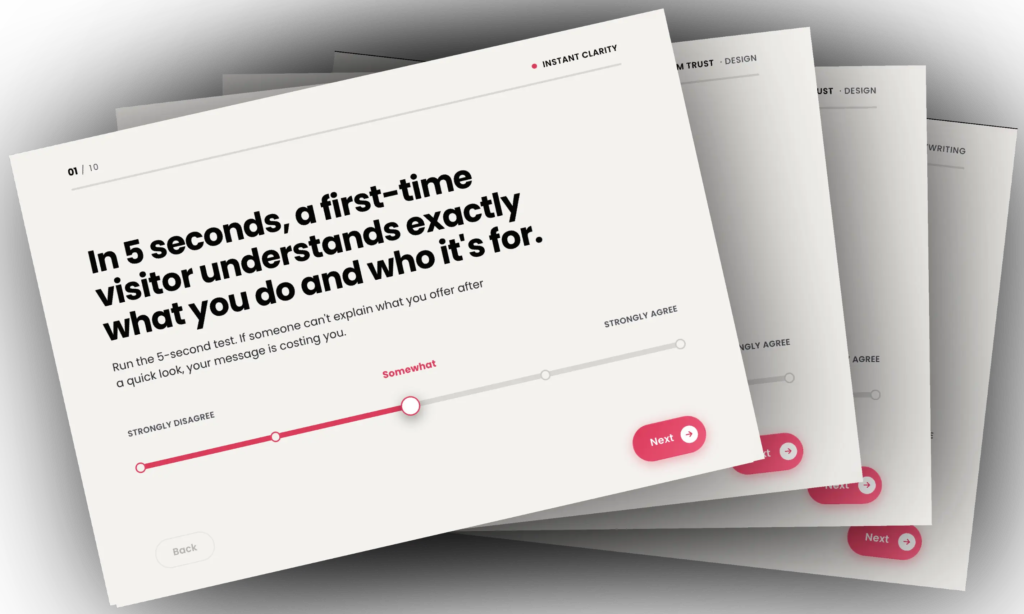
Whether someone arrives via Google or ChatGPT, they need to understand within seconds: what you do, who you serve, and why they should choose you.
Confusion kills conversions. When a visitor can’t quickly grasp your value proposition, they leave. It doesn’t matter if AI recommended you, if your message is muddled, you’ve lost them.
Your headline should pass the “grandmother test.” If your grandmother (who knows nothing about your industry) can read your headline and explain what you do and for whom, you’ve nailed clarity. If she’s confused, your ideal client will be too.
Clarity means:
- One clear message per page, not trying to say everything at once
- Benefits before features, “Scale to $2M in 18 months” not “Our proprietary 12-module system”
- Specific language over vague promises: “We help B2B SaaS companies” not “We help businesses grow”
- Simple words that a 7th grader could understand, not industry jargon
Trust Must Be Earned, Not Claimed
You can’t just say you’re trustworthy. You have to prove it. And AI-referred visitors, despite coming with positive intent, still need to verify that you’re the real deal.
Trust signals that actually work:
Authentic Social Proof: Real testimonials from real people with real results. Video testimonials are 10x more powerful than text. Include names, companies, and specific outcomes. “This coach helped me scale from $300K to $1.2M in 14 months” beats “Great coach, highly recommend” every time.
Case Studies With Numbers: Generic success stories don’t build trust. Specific numbers do. “Increased revenue by 300%” means more than “saw significant growth.” Show the before, the process, and the after. Make it real and tangible.
Credentials That Matter: Not all credentials are created equal. Display the ones your market actually cares about. If you’re selling to enterprises, show your Fortune 500 client list. If you’re helping startups, show your startup success stories. Match credentials to what your market values.
Demonstrate Expertise Through Content: Your blog posts, videos, podcasts, and resources prove you know what you’re talking about. Depth of free content signals confidence. If you’re giving this much away for free, what must the paid offering be like?
Design Balance Creates Professional Credibility
Design is where many businesses undermine themselves. Two extremes both fail:
The Template Trap: Using an obvious template with stock photos signals that you didn’t invest in your own business. If you won’t invest in yourself, why should clients invest in you? Generic templates scream “I’m not established enough to afford custom design.”
The Overdesigned Mess: On the flip side, websites crammed with parallax scrolling, complex animations, video backgrounds, and auto-playing media look “fancy” but perform terribly. They’re slow to load (Google penalizes slow sites). They’re distracting (visitors can’t focus on your message). And they’re often harder to use, especially on mobile devices where most traffic comes from.
The Sweet Spot: Professional, polished, purposeful design that directs attention to your message. Think of design like a picture frame, it should make the art (your content) stand out, not compete with it.
Great design means:
- Fast loading times—every second of delay costs you conversions
- Mobile-first approach—over 60% of traffic is mobile, and that number’s climbing
- Clear visual hierarchy—visitors should know where to look first, second, third
- Strategic white space—letting your content breathe makes it more digestible
- Consistent branding—colors, fonts, imagery that reinforce your positioning
Conversion Psychology Is Timeless
Human psychology doesn’t change just because the discovery mechanism does. People still make decisions the same way they always have.
Universal psychological principles that drive conversions:
Loss Aversion: People are more motivated to avoid loss than to gain something equivalent. “Stop losing $50K/year to inefficiency” often works better than “Gain $50K/year in savings.” Same number, different framing, different emotional response.
Social Proof: We look to others to validate our decisions. When we see that “people like us” have succeeded with your solution, it lowers our perceived risk. This is why testimonials from relatable customers work so powerfully.
Authority: We defer to recognized experts. Your credentials, media appearances, client roster, and thought leadership all build authority that makes choosing you feel safer.
Reciprocity: When you give value first (comprehensive free content, tools, resources), people feel compelled to give back. This is why lead magnets work, you’re triggering reciprocity.
Scarcity and Urgency: Limited spots, enrollment windows, or bonus deadlines create action. But this only works if it’s genuine. Fake scarcity destroys trust.
AI changes how people find you. It doesn’t change what makes them trust you, value you, and ultimately choose to work with you.
Positioning Matters More Than Ever
In an AI-driven world, generic businesses become invisible. If you’re “a full-service digital agency” or “a business coach for entrepreneurs,” there’s nothing distinctive for an AI to hang its recommendation on.
But if you have a specific methodology, a defined niche, or a differentiated approach, that gives AI assistants something concrete to recommend.
Compare these two positioning statements:
Generic: “We’re a business coaching firm that helps companies grow.”
Specific: “We help B2B SaaS companies scale from $1M to $10M ARR using our Revenue Architecture Framework™.”
The second one is memorable. It’s citeable. It tells you exactly who it’s for and what makes it different. An AI assistant can easily explain why someone might want to check them out.
Your positioning needs to answer:
- Who specifically do you serve? (Not “businesses”, be narrow)
- What specific outcome do you deliver? (Quantifiable when possible)
- What makes your approach unique? (Your methodology, framework, or process)
- Why should someone choose you over alternatives? (What’s your unfair advantage?)
Strong positioning isn’t just marketing fluff anymore. It’s how you become discoverable and recommendable in the age of AI. It’s the difference between being lost in the noise and being the obvious choice.
Future-Proofing Your Website: AI Tools and What Really Matters
The Reality of Vibe Coding
Tools like Replit and v0 let you vibe code a basic website in an afternoon. But here’s what typically happens: bugs need debugging, responsive design breaks, performance isn’t optimized, content strategy is absent, and you’re spending hours troubleshooting instead of running your business.
AI coding tools are excellent for prototyping, but they’re not a replacement for strategic thinking about positioning, conversion psychology, and business goals.
What’s Coming Next
At Studio1 Design, we’re waiting for the day when we can design in Figma, import into an AI tool, and generate perfect responsive code that deploys instantly to any platform. When that arrives, we’ll focus entirely on brand strategy, conversion optimization, and continuous improvement.
The Dynamic Website Future
Websites are heading toward being dynamic, continuously evolving assets. Imagine constantly testing and optimizing: new headlines monthly, different calls-to-action based on performance, content updates driven by AI-referred visitor behavior.
What Will Never Change
No matter how sophisticated AI tools become:
- Understanding your audience requires deep customer research
- Strategic positioning requires human insight
- Conversion psychology requires understanding human behavior
- Brand differentiation requires creative thinking
AI tools accelerate execution. They don’t replace strategic thinking, customer understanding, and conversion expertise.
Real-World Example: Thriving in the AI Era
A professional services firm came to us after seeing a 35% traffic drop over six months. Their first instinct was panic. But the issue wasn’t their rankings, their competitors had the same problem. This was the AI shift.
The bigger problem: their website wasn’t structured for AI discovery. Content was thin and promotional. Positioning was generic. Nothing for an AI assistant to reference.
What We Changed
Content Transformation: We created comprehensive educational resources positioning them as thought leaders. In-depth guides explaining their methodology with detailed FAQ sections.
Positioning Clarity: Developed a unique positioning statement and methodology name. They became specialists with a named, citeable framework.
Structural Optimization: Implemented semantic HTML, clear heading hierarchies, and structured content for easy AI parsing.
Conversion Optimization: Redesigned for AI-referred visitors who arrive pre-qualified. Focus on confirming recommendations rather than aggressive sales tactics.
The Results
Six months later:
- Traffic stabilized (decline stopped)
- Conversion rates increased 40%
- Consultation bookings doubled
- Sales cycle shortened
- ChatGPT now recommends them when prospects ask about their space
Fewer visitors, but better visitors. Lower traffic numbers, higher revenue. This is success in the AI era.
Frequently Asked Questions
Is my website traffic dropping because of AI, or is there something wrong with my website?
If your traffic has declined 30-40% over the past year but your search rankings haven’t dramatically changed, you’re likely experiencing the AI shift, not a website problem. Check if your competitors are seeing similar patterns. The key question isn’t “how do I get my traffic back?” but rather “how do I optimize for the new reality where fewer visitors arrive but they’re higher quality?” Focus on conversion rate optimization and positioning your content for AI recommendations rather than chasing vanity traffic metrics.
How do I know if AI assistants are recommending my business?
Test it directly. Ask ChatGPT, Claude, or Perplexity questions that your potential customers would ask. For example: “Who are the best business coaches for scaling service businesses?” or “What should I look for when hiring a business coach?” See if your business gets mentioned. If not, you have work to do. You can also ask prospects how they found you, increasingly, people are mentioning that an AI assistant recommended looking into your services. This is your signal that your positioning and content strategy are working.
Should I stop investing in traditional SEO now that AI is changing search?
No, but your SEO strategy needs to evolve. Traditional SEO fundamentals still matter: site speed, mobile optimization, technical structure, quality content. But shift your content focus from keyword optimization to comprehensive education. Instead of targeting “business coach near me” with thin content, create authoritative resources about scaling principles that AI assistants can reference. The goal isn’t just ranking for keywords anymore; it’s becoming a citeable authority on your topic. Bottom-of-funnel, intent-driven content is more valuable than high-volume generic keywords.
What’s the minimum content length for AI assistants to recognize my expertise?
There’s no magic number, but depth matters more than length. A comprehensive 2,000-3,000-word article that thoroughly explains a concept will outperform ten shallow 300-word posts. AI assistants can recognize substantive content versus fluff. Focus on genuinely teaching concepts, explaining your methodology, providing actionable frameworks, and demonstrating nuanced understanding. Include clear structure with semantic HTML, direct answers to common questions, and original insights rather than regurgitated generic advice. Quality and comprehensiveness trump arbitrary word counts.
If AI is intercepting traffic, why do I still need a website at all?
Because AI doesn’t close deals, you do. AI assistants provide recommendations, but people still want to verify those recommendations by visiting your website. Your site needs to confirm what the AI said about you, demonstrate your expertise more deeply, build trust through your positioning and content, and provide clear next steps for taking action. Think of AI as the introduction and your website as the deeper conversation. Without a strong website, even AI-referred visitors will bounce. The game has changed from “how do I get found?” to “how do I convert the qualified visitors AI sends me?” Both require strategic website optimization.
The AI Revolution Is Here. Are You Ready?
Website traffic is shifting from search engines to AI assistants. This shift is accelerating, not slowing down.
You have two choices: panic about declining numbers and hope things return to “normal,” or recognize this as the biggest shift in online discovery since Google and position yourself to thrive.
The businesses that win in the AI era aren’t the ones with the most traffic. They’re the ones AI assistants recommend, those with clear positioning, comprehensive educational content, and strategic conversion optimization.
Success Metrics Have Changed
In the AI era:
- Traffic quality matters more than volume
- Conversion rates matter more than visitor counts
- Being citeable matters more than ranking #1
- Educational content matters more than promotional
- Positioning clarity matters more than generic messaging
The Fundamentals Still Matter
AI changes how people find you, not what makes them choose you. When AI-referred visitors arrive, you still need crystal clear positioning, customer-focused messaging, design that enhances your message, strategic conversion paths, and content that confirms their recommendation.
Test Where You Stand
Ask AI assistants questions that your potential customers would ask. Do you show up in those conversations? If not, audit your content:
- Is your positioning distinctive or generic?
- Is the content deep and educational or shallow and promotional?
- Do you have a citable framework or methodology?
- Is your site structured with semantic HTML?
- Do you answer questions directly and comprehensively?
These aren’t just tactics, they’re fundamentals of being a trusted authority. AI simply rewards what should have been best practice all along.
Get Expert Help
If you’re seeing traffic decline but aren’t sure how to adapt, we can help. We offer free website audits assessing both your positioning and AI-readiness. We’ll tell you exactly what’s working, what’s not, and what changes will make the biggest impact.
The AI revolution isn’t coming. It’s here. Will you adapt and thrive, or watch your traffic decline while competitors figure out the new game?
Book your free strategy call and turn the AI revolution into your competitive advantage.
Or grab my book, Next Level Website Design, covering the timeless fundamentals of audience psychology, positioning, and conversion optimization that matter whether someone finds you through Google, ChatGPT, or word of mouth.