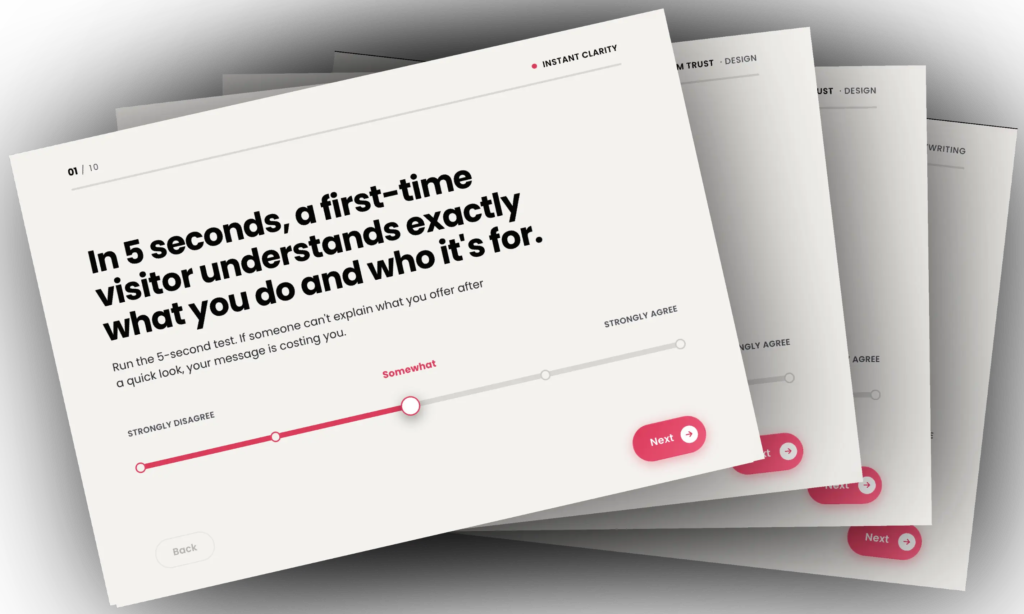
In this short video, you will discover the five principles that separate high-performing websites from ones that look good but don’t convert. Watch the overview, then read on for a deeper breakdown of each principle with real examples.
Key Takeaways
- Visitors decide within seconds whether your website is worth their time, clarity, and trust signals shape that judgment fast
- Psychology-driven web design influences how people think, feel, and decide, not just how a page looks
- These five principles work together and compound; missing even one creates a gap that limits what the others can do
Most business owners know their website should be “doing more.” But what does that actually mean, and where do you start?
Does your website experience any of these common problems?:
- Does your website have low conversions?
- Is your website is generating traffic, but it’s struggling to convert visitors into hot leads and sales.
- Is your website embarrassing, and do you feel embarrassed to show it off
- Does your website lacks clarity and confuse your visitors? They leave, and you don’t even know why.
- Is your website has an average design? Maybe it’s dated, maybe you designed it yourself. It just doesn’t look pro-level.
- Is your website is doing a poor job at positioning your brand uniquely, so there’s no reason to choose you over your competitors.
- … and perhaps you feel like your website is holding you back from reaching your full potential.
If any of these problems sound familiar, don’t worry, you’re definitely not alone. And more importantly, every single one of these issues is completely fixable!
To help fix your website problems, explain why they work, and show you a real example of them in practice, let’s unpack the five principles:
- Principle 1: Understand Your Audience
- Principle 2: Brand Positioning
- Principle 3: Marketing Strategy
- Principle 4: Psychological Influences
- Principle 5: Conversion-Focused Design
Principle 1: Understand Your Audience
When someone lands on your website, they’re not thinking about you. They’re thinking about themselves. The only question on their mind is: what’s in it for me?
That’s not a cynical observation, it’s just how people use the web. They arrive with a problem they want solved, a question they need answered, or a decision they’re trying to make. If your website doesn’t speak to that immediately, they move on.
The most effective websites flip the script. Instead of leading with who the business is and what it does, they open with what the visitor is experiencing and how the business can help. Think of it as positioning your brand as the guide and your visitor as the hero. Your job isn’t to talk about yourself, it’s to show visitors you understand their situation and can help them get to where they want to be.
This sounds obvious, but it’s the most commonly skipped step in website design. Businesses spend weeks on colors and fonts while spending almost no time understanding what their visitors actually care about.
In Practice: PrimalTrust.org
PrimalTrust is a wellness and healing platform focused on nervous system health and trauma recovery. Their audience arrives in a particular state of mind, they’ve often spent years looking for something that actually works. They’re not casual browsers. They’re people in genuine need of a solution, and they’re evaluating whether this is the right one.
For a website like this, audience understanding isn’t just a strategy, it’s the whole foundation. The messaging needed to reflect what visitors were carrying before they even clicked the link. The design needed to feel safe, credible, and clear from the first moment on the page. Rather than leading with product features or sign-up prompts, the site was built around the visitor’s experience: what they’re struggling with, what they’re looking for, and what makes PrimalTrust different from everything else they’ve tried.
When your website starts with the visitor’s reality instead of your own story, the whole experience shifts. Visitors feel understood, and that’s usually what it takes for them to keep reading.
Take the time to deeply understand your audience before designing a single page. Their pain points, their questions, their hesitations. That knowledge shapes everything that follows.
Principle 2: Brand Positioning
How visitors perceive your brand shapes whether they trust you enough to act. And perception starts forming before anyone reads a single word.
Most industries suffer from sameness. Everyone uses the same language, the same stock photography, the same page layouts. When all the options in a market look and sound alike, people default to price. If you don’t give visitors a reason to choose you specifically, you become just another option, and the cheapest option tends to win.
Effective brand positioning means identifying what’s genuinely distinctive about your business and building that into everything your website communicates. It’s not about inventing a unique selling point from scratch. It’s about uncovering what already makes your business different and making sure your website reflects that clearly.
There’s also a price-authority connection worth understanding. The more credible and professional your brand appears, the more people are willing to pay. A dated or generic-looking website can undermine a premium offer before a visitor even reads your pricing. Design communicates value before words get a chance to.
In Practice: BrodyLee.com
Brody Lee is a personal trainer and fitness expert with a background that sets him apart, he brings a distinct approach to his craft, and his website needed to reflect that clearly rather than blend into a crowded market full of similar-looking fitness sites.
The design was built around differentiation. Instead of borrowing the standard aesthetics of the fitness industry, the dark backgrounds, aggressive typography, before-and-after photo grids, the site was positioned to reflect Brody’s specific philosophy and the type of client he works with. The visual brand and messaging worked together to signal authority and specificity from the first scroll.
The result is a website that doesn’t look like everyone else’s. Visitors can tell immediately that this isn’t a generic offering, and that clarity of positioning makes the decision to enquire far easier.
Study your competitors before you design your website. Then deliberately zig where they zag. What’s genuinely different about your approach, your experience, or your results? That’s what your website should lead with.
Principle 3: Marketing Strategy
Here’s a number that changes how you think about your website: 97% of visitors aren’t ready to buy when they first land on your page.
Most of them are researching. They’re comparing options, building trust, or just getting a feel for whether you’re the right fit. If your website only speaks to the 3% who are ready to act right now, you’re leaving the other 97% with nowhere to go, and they’ll go somewhere else.
A conversion-focused website needs to cater to three types of visitors at once. Cold visitors don’t know you yet, they need a reason to stick around and a low-risk way to stay in touch, usually through a free, high-value resource (a lead magnet) in exchange for their email address. Warm visitors have engaged with your brand before, they need trust-builders like case studies, testimonials, and helpful content. Hot visitors are ready to act, they just need a clear, frictionless path to do it.
The biggest mistake is treating the website like a static brochure. A brochure doesn’t adapt to where someone is in the decision process. A well-structured website does.
In Practice: KatherineGreenland.com
Katherine Greenland is a practitioner and educator whose audience spans a wide range of readiness. Some visitors arrive knowing exactly what they want. Others are still exploring whether her work is the right fit for them.
The website was designed to serve both without making either feel like they’re going through the wrong door. Cold visitors are met with clear educational pathways that build understanding and trust. Warm visitors can find case studies and testimonials that help them evaluate with confidence. And those who are ready to take the next step have a direct, clear route to do that without having to dig for it.
The website also captures leads through a free resource that reflects Katherine’s expertise, so visitors who aren’t ready to buy immediately stay in contact, and that relationship has room to develop.
Before you design your website, ask yourself: what does a first-time visitor need to see? What does someone who already knows my work need? And how do I make it easy for someone who’s ready to buy to do exactly that? Build your website around those three questions.
Principle 4: Psychological Influences
People don’t make decisions on logic alone. Most purchasing decisions are driven by emotion first and justified by logic second. That’s not a manipulation tactic, it’s just how human decision-making works, and your website either works with that reality or against it.
Psychologist Robert Cialdini identified a set of influence principles that show up in almost every buying decision: authority, social proof, reciprocity, liking, consistency, scarcity, and unity. Applying these ethically to your website means giving visitors the signals they need to feel confident about moving forward.
Authority means showing your credentials, experience, and expertise clearly, not burying them. Social proof means letting other people’s experiences do the persuading for you. Reciprocity means giving real value before you ask for anything in return. Liking means being human and relatable, not just professional. Consistency means maintaining the same voice and visual identity everywhere a visitor might encounter your brand.
When these elements are working together on a website, visitors feel confident. When they’re missing, visitors hesitate, even if they can’t articulate exactly why.
In Practice: SaxSchoolOnline.com
Sax School Online is a global saxophone membership site founded by Nigel McGill. Before the redesign, the website had a YouTube audience that wasn’t converting into paying members at the rate the business deserved. The design looked homemade. The unique value of the membership, which worked out to less than $1.50 per day, wasn’t visible to visitors. And the psychological trust signals that would have helped visitors feel confident about joining simply weren’t there.
The redesign applied Cialdini’s influence principles systematically across the site. Nigel’s authority was made explicit: decades of performing and teaching experience, credentials, professional photography, and media logos. Social proof was built out with a dedicated reviews page, video testimonials showing real students playing learned pieces, and a visible member count. The lead-in changed from a generic email signup to a free Saxophone Starter Pack, a genuine give-before-you-ask that demonstrated the quality of what members would receive. Risk was removed with a 14-day free trial and a 90-day money-back guarantee.
In the 12 months following the redesign, the website saw over 1,000 new paying members and more than 25,000 new email subscribers, with warm traffic conversion rates doubling. Every business is different, and results depend on market conditions, audience, and implementation, but this example illustrates what becomes possible when psychological trust signals are applied with intention across an entire website.
Think about each Cialdini principle as a question your website needs to answer. What makes you the authority? What do others say about working with you? What are you giving before you ask? When each of those questions has a clear answer on your website, visitors have far fewer reasons to hesitate.
Principle 5: Conversion-Focused Design
Design isn’t decoration. It’s how visitors are guided through your website, from attention to understanding to action.
A website with a bad design is a bit like bad breath: nobody tells you, they just avoid you. The visual presentation of your business shapes how seriously people take you before they’ve read a single word. If the design looks dated, generic, or inconsistent, the instinctive response is to question whether the business behind it can be trusted with something important.
Conversion-focused design means that every element on the page has a purpose. Visual hierarchy tells visitors where to look first, second, and third. White space helps them absorb information without feeling overwhelmed. CTAs are visually prominent and specific. Images support the message rather than sitting as decorative filler. The whole page works as a system, guiding visitors from arrival to action in the most natural way possible.
In competitive markets, professional design isn’t optional, it’s a signal of credibility. Industry leaders invest in design because they understand it raises the perceived value of everything they offer. Average design risks making a strong business look like an average one.
In Practice: YoshaLaw.com
Yosha Law is a personal injury law firm that needed to stand out in one of the most competitive and visually homogeneous industries online. Most law firm websites look and feel the same: formal stock photography, dense copy, generic layouts that signal nothing distinctive about the firm behind them.
The redesign started with a 12-page mood board before a single page was designed. That process established the brand’s entire visual identity, the colors, imagery style, typography, and overall feel, so that when design began, every decision was grounded in a clear, deliberate positioning rather than personal preference or industry convention.
The final website communicates authority and trust from the first scroll. The visual language is distinctive without being distracting. The layout guides visitors toward the key actions without competing elements pulling them in multiple directions. And because the design matches the firm’s actual caliber, it attracts the kind of client the business is built to serve.
From 12 motor vehicle accident cases in an entire year before the redesign to 16 high-value cases in the first month after launch, this example shows what becomes possible when conversion-focused design is applied to a complete brand repositioning. Every business is different, and results will vary based on market, competition, and implementation.
If you want your website to convert, design with purpose. Ask what each element is doing for the visitor, not what it’s doing for the aesthetic.
How These Principles Work Together
It’s worth being direct about something: these five principles compound. They’re not a checklist where you pick the two or three that feel most relevant and ignore the rest.
A beautifully designed website without a marketing strategy is an expensive brochure. Deep audience understanding without clear positioning means the message reaches the right person but doesn’t land. Psychological trust signals without conversion-focused design mean visitors feel good about your brand but don’t know what to do next.
Every principle addresses a different gap in the conversion process. When all five are in place, they reinforce each other. When one is missing, the others can only do so much.
Frequently Asked Questions
Q: Do I need all five principles, or can I focus on just one or two?
A: The principles are designed to work together. Applying one or two in isolation often leads to partial results. A website with strong positioning but no marketing strategy, for example, may attract the right visitors but fail to capture them. Start with whichever principle is most clearly absent from your current website, then build from there, but keep all five as the target.
Q: How is conversion-focused website design different from regular web design?
A: Most web design focuses on aesthetics, how the site looks. Conversion-focused website design starts with strategy: who the visitor is, what they need to see, and what action they should take. The design is the delivery mechanism for that strategy, not the goal in itself. A site can be visually impressive and still fail to convert if the underlying strategy isn’t sound.
Q: My website looks fine. How do I know if it’s actually working?
A: A few things worth checking: Are visitors spending meaningful time on the page? Are they opting in, booking calls, or making enquiries at a rate you’d expect given your traffic volume? If the answer is no, the issue is often structural, messaging clarity, visitor pathways, or missing trust signals, rather than purely visual. A website that “looks fine” can still have significant conversion gaps.
Q: Is psychology-driven web design relevant for smaller or newer businesses?
A: Yes. The psychological principles that shape how people make decisions don’t change, based on business size. A first-time visitor to a small consultancy’s website is running the same mental evaluation as a visitor to a large firm’s website. The implementation scales with the business, but the foundation is the same regardless of where you’re starting from.
Q: How long does it take to see results from applying these principles?
A: It depends on traffic volume, the scope of changes, and market conditions. Initial patterns often become visible within the first few months after a redesign. Meaningful, compounding improvement typically comes from treating the website as an ongoing asset, tested and refined over time, rather than a one-off project. A website is never truly finished.
A high-performing website isn’t about trends, templates, or picking the right platform. It’s about building on the right principles, understanding your audience, positioning your brand clearly, developing a marketing strategy, applying psychological influences, and executing with conversion-focused design.
When these five principles work together, your website stops being a cost and starts functioning as a genuine business asset. It communicates credibility before visitors read a word. It gives them reasons to stay, reasons to trust, and a clear path to take action.
If you’d like to understand how these principles apply to your specific website, we offer a free strategy call. No pitch, no pressure, just a focused conversation about what’s working, what isn’t, and where the opportunity is.
Most visitors arrive at a website asking three questions, usually within the first few seconds.
Does this look like it’s for me?
Can I trust these people?
What should I do next?
When a website is built to answer those questions, in that order, visitors stay longer, trust more quickly, and take action. That discipline is structural, and it doesn’t require a bigger budget, just a clearer approach. If you’re not sure how your website holds up against those questions, a fresh set of eyes is often the most useful place to start.
We offer a no-pressure 15-minute strategy call for business owners who want an honest read on what their website is — and isn’t — doing for them.
Next Level Website Design Greg’s New Book, Out Now!
Your blueprint to designing a high-converting website. Packed with proven strategies to boost your results in any niche.