Is your website actually converting visitors into customers?
If not, reading a book on website design feels like the right move. The challenge is, with dozens of options out there, which ones are worth your time?
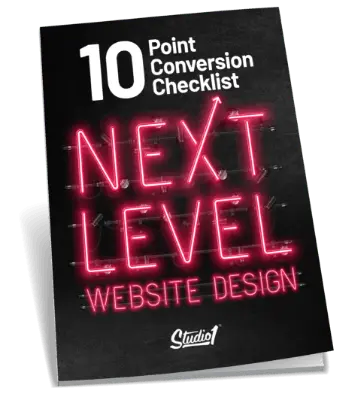
Some of the most popular books cover usability, brand positioning, user experience, or conversion tactics. Each provides valuable insights, but most focus only on one part of the puzzle. That’s why Greg Merrilees, CEO of Studio1 and author of Next Level Website Design, highly recommends a handful of standout titles.

These books have influenced his own thinking and shaped parts of Next Level Website Design. What makes Greg’s book different, though, is how it builds on these principles and integrates them into a complete framework that connects strategy, psychology, design, and conversions.
In this article, we’ll highlight some of the best books on website design and show you how Next Level Website Design both draws from and expands on them.
What Website Design Books Typically Cover
Most website design books do a great job of teaching the fundamentals, things like usability best practices, user-friendly navigation, clean layouts, and essential coding or functionality.
Many also highlight visual design, offering inspiration through aesthetic showcases, or drill into specific elements such as forms, typography, or even design psychology.
These books are valuable because they establish the mainstream principles and rules of thumb that every designer or business owner should know. However, only a handful take a deep dive into conversion strategies, the kind that directly influence whether visitors become customers.
And here’s where things get tricky: with AI and no-code tools, anyone can design and launch a website in minutes. The real challenge is no longer just getting a website online, it’s creating one that actually converts visitors into paying customers. What worked a few years ago may not cut it today, because customer expectations are changing while competition gets stronger every day.
That’s why it’s worth asking: which book not only covers the fundamentals but also stays relevant in helping you design websites that perform right now?
Why Choosing the Right Website Design Book Matters
Every website book adds value, but the real magic happens when you find one that helps you connect the dots.
The right book gives you a clear framework, so your website isn’t just a collection of tactics, but a cohesive system that works as hard as you do. One that turns traffic into trust, and trust into action.
With that in mind, here are 7 powerful reads that bring unique strengths to the table, each one adding a piece to the bigger picture of what makes websites truly convert.
7 Valuable Website Design and Conversion Books to Consider
Don’t Make Me Think by Steve Krug

Even though this book was originally published in 2000, its principles remain timeless and consistently impactful.
This classic cuts through the noise to reveal the core of web usability: a website should be so clear and intuitive that users never have to pause or scratch their heads. Steve’s first law of usability is literally “Don’t make users think”. Every page element should be self-evident and obvious.
He uses sharp humor and real-world examples to make UX principles accessible, even for those with no design background. One standout insight is that people scan website pages rather than read them, so your design must cater to quick scanning with clear visuals and obvious navigation cues.
This visually engaging book is packed with practical, jargon-free tips you can apply right away, and it emphasizes testing those ideas with real users.
Steve’s mantra, “Don’t argue, test,” encourages frequent usability testing (even with just a few users) to catch issues and settle debates, since even small tweaks can massively improve the user experience.
Building a StoryBrand by Donald Miller

This book simplifies your message so customers instantly “get it.” The StoryBrand framework positions the customer as the hero and your business as the guide, making your website’s communication more engaging and relatable.
In practice, this means clarifying what you offer in a way that highlights how you solve the customer’s problem and guides them to a clear next step. The book provides a concrete structure for your home page – from a compelling header and straightforward call-to-action down to a logical flow of problem, solution, and outcome. This structure removes guesswork by showing exactly how to lead visitors through a narrative journey: identify their problem, present your solution as the plan, and then call them to action.
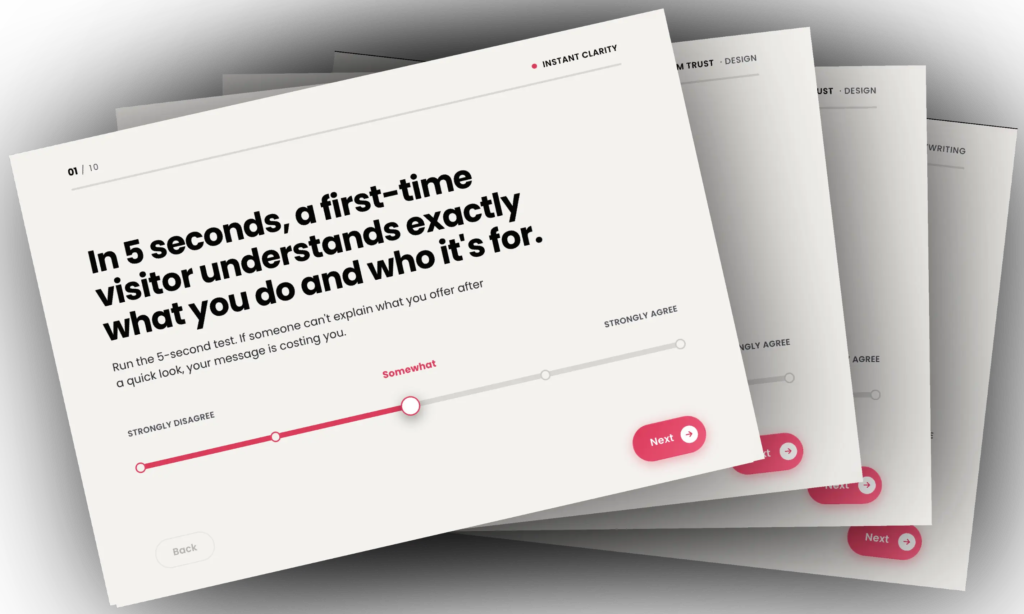
According to the book, a visitor should be able to answer three questions within five seconds: What do you offer? How will it make my life better? And what do I need to do to buy it?
The end result is a website that resonates with customers and presents your offers in a way that’s incredibly clear and compelling.
Landing Page Optimization: The Definitive Guide to Testing and Tuning for Conversions by Tim Ash, Maura Ginty, and Rich Page

This guide provides a detailed, research-backed playbook for optimizing website pages. It delves into the psychology behind user decisions, explaining how design choices – like layout, colors, wording, and buttons – influence behavior on a subconscious level.
Backed by cognitive science and real case studies, the book shows why visitors click (or don’t) and how to nudge them toward conversion. It takes a scientific, data-driven approach, teaching you to formulate hypotheses and A/B test everything. The authors outline step-by-step testing methods and even discuss advanced tools like eye-tracking and mouse-tracking to understand user behavior.
It’s incredibly actionable, with checklists and frameworks to systematically improve every element of your page – from headlines and images to forms and call-to-action placement.
In fact, Landing Page Optimization is so comprehensive that it goes beyond landing pages. It covers the full optimization cycle: defining your goals, understanding your audience, creating value propositions, designing page layouts, and rigorously measuring results.
The book emphasizes that you (and your team) are not the ultimate expert – the data is. By continuously testing and tuning, often even small tweaks, you can steadily boost conversions and turn more of your visitors into leads and customers.
The Marketer as Philosopher by Flint McGlaughlin

This book isn’t your typical “how-to” marketing guide. It challenges you to think deeper about why your marketing works (or doesn’t). It urges marketers to move beyond surface-level tactics and become “philosophers,” asking the fundamental questions behind their messaging. The book is structured as 40 brief reflections (gleaned from 25+ years of research and testing in Flint McGlaughlin’s “web laboratory”) focused on the power of your value proposition.
In practical terms, it explores how to craft value propositions and communication that truly resonate with customers at a core level, the kind of messaging that makes someone say “yes, this is for me.” For example, Flint introduces the concept of the “micro-yes funnel,” the idea that your webpage should guide users through a series of tiny yeses (small agreements or engagements) leading up to the final conversion.
He also warns against the “flawed ask,” where marketers push for a sale or commitment before they’ve built sufficient value or trust.
By combining strategic thinking with insights into human behavior and decision-making, Flint shows how each piece of your content – headlines, offers, calls-to-action – should answer why that matters to the customer.
The ultimate takeaway is a framework for building long-term customer relationships: instead of chasing quick wins, you learn to create meaningful engagement by communicating your value in a way that aligns with the customer’s mindset and needs.
Making Your Website Work: 100 Copy & Design Tweaks for Smart Business Owners by Gill Andrews

Gill Andrews offers a no-nonsense, hands-on guide that packs in 100 quick fixes to make your website convert better right now. Unlike theory-heavy books, this one is all practical, bite-sized tips, exactly the kind of actionable advice that busy business owners and DIY web designers appreciate.
It directly tackles the common website mistakes that quietly kill your conversions: confusing or self-centered copy, cluttered pages, burying important info, weak calls to action, slow load times, you name it. Each tip is presented as a specific problem to check for and a clear solution to implement. For example, Gill shows how to spot vague, “me-focused” headlines and rewrite them into customer-focused value statements.
She points out if your navigation is unclear or your contact info is hard to find, and then tells you how to fix it in plain English. The advice spans both copy and design, reflecting Gill’s expertise in conversion copywriting and usability. Designers will get concrete guidance on layouts that highlight your message (not hide it), and on design choices that make pages easy to scan and trust. Business owners will learn to sharpen their writing – removing fluff, adding clarity, and addressing customer concerns head-on, without needing a marketing degree.
Every one of the 100 tips is something you can apply on the spot to instantly improve your website. It’s like having a checklist of website do’s and don’ts compiled from real-world experience with small businesses and startups.
Making Websites Win by Karl Blanks and Ben Jesson

This guide provides a systematic approach to turning your website into a money-making machine. It isn’t about making websites just look pretty; it’s laser-focused on conversion optimization and backed by the authors’ experience boosting results for companies like Google, Facebook, and Amazon.
What’s different here is the methodology: the authors walk you through a repeatable process of researching your audience, hypothesizing changes, testing them, and continuously refining, a cycle of constant improvement so your website is never “done.” In fact, they argue that websites should never be static brochures; instead, you should be running experiments all the time to squeeze more leads and sales from the traffic you already have.
The book starts by bluntly explaining “Why most website design is done wrong”. It provides a toolkit for diagnosing where your website is leaking money, covering 15+ techniques from user surveys and analytics to usability tests.
Throughout the book, you’ll find tons of real examples and case studies – many drawn from the authors’ work with customers, illustrating how a particular change (say, rewording a headline or simplifying a checkout form) led to a significant increase in conversions.
By the end, you’ll not only have a heap of practical CRO techniques to try, but also a conversion mindset: a realization that making a website “win” is about relentless empathy for the customer and a willingness to test every assumption.
The Principles of Beautiful Web Design by Jason Beaird and James George

This book zeroes in on the fundamentals of visual website design, making it perfect for non-designers and designers alike who want to create websites that look great and feel right. Rather than covering conversion or marketing tactics, Jason and James break down the core principles of design in an easy-to-follow way, dedicating chapters to layout & composition, color theory, texture, typography, and imagery.
You’ll learn how to use grids and arrange content in a balanced layout that guides the visitor’s eye naturally (so your pages feel effortless to navigate).
You’ll see how choosing the right color scheme can evoke the desired emotion or brand vibe, and how to apply color consistently across your website for a cohesive feel. The authors also demonstrate basic typography tricks – selecting complementary fonts, setting readable line lengths, and using hierarchy (like headings, subheadings, etc.) – to make sure your message comes across clearly and attractively.
One thing this book does especially well is show before-and-after examples: you might see a mediocre webpage design and then see it transformed after applying the principles in the book. By walking through these transformations, the authors make abstract concepts (like “visual hierarchy” or “white space”) very concrete and understandable. The importance of consistency is stressed throughout – from sticking to a coherent style guide, to maintaining uniform navigation elements – because a consistent design builds trust with users.
How Next Level Website Design of Greg Merrilees Takes a Different Approach
So where does Next Level Website Design, fit in?
Greg Merrilees has studied and applied many of the timeless principles you’ll find in these classic books, from Steve Krug’s usability wisdom to Donald Miller’s StoryBrand framework, from Tim Ash’s data-driven testing to Gill Andrews’ quick-fix tips. These resources provided powerful building blocks.

But here’s the difference: Greg didn’t just read them, he battle-tested the principles on more than 2,000 real businesses across industries. That pressure to deliver measurable results, not just theory, shaped the five-principle framework at the heart of Next Level Website Design,
In short, Greg’s book doesn’t replace these other works; it integrates their strengths and then goes further. It connects the dots between brand positioning, customer psychology, marketing funnels, and design strategy into one cohesive system designed to convert.
Next Level Website Design is full of frameworks that generated measurable business results across wildly different industries. The same strategic approach that helped Yosha Law go from 12 cases per year to 16 in their first month also enabled a saxophone teacher to add 1,000+ members in 12 months.
From Hollywood celebrities to local service providers, these principles had to consistently deliver ROI or the business would fail. This real-world pressure to produce results across such diverse customers creates a level of practical reliability that academic research or consulting case studies simply can’t match.
It’s battle-tested across 2,000+ websites.
This book comes from someone who had to prove ROI with real paying customers, not just share theoretical principles or cherry-picked case studies. When Steve Krug teaches usability or Tim Ash explains testing methodology, they’re sharing proven concepts. When Greg explains his five-principle framework, he’s sharing what literally had to work or customers would stop paying him.
The difference is accountability: these aren’t principles that sound good in theory. They’re frameworks that had to generate measurable business results across wildly different industries. The same strategic approach that helped Yosha Law go from 12 cases per year to 16 in their first month also enabled a saxophone teacher to add 1,000+ members in 12 months.
From Hollywood celebrities to local service providers, these principles had to consistently deliver ROI or the business would fail. This real-world pressure to produce results across such diverse customers creates a level of practical reliability that academic research or consulting case studies simply can’t match.
It starts with your business outcomes, not design preferences.
Next Level Website Design doesn’t start with fonts, colors, button styles, or design checklists; it starts with your business goals.
Before you ever design a page or write a headline, the book asks: “What result are you trying to achieve?”
That means reverse-engineering your website from the outcomes you want, whether it’s getting more qualified leads, promoting higher-ticket sales, or launching a new offer. Design becomes the tool, not the starting point.
This approach solves the single biggest problem with most website projects: They look great but don’t perform, because they were based on design taste, not strategy.
Next Level Website Design reveals how strategy drives design, not the other way around.
It solves the integration problem that other books create.
Most books excel in their specialty. Donald’s StoryBrand framework is brilliant for messaging, Tim’s optimization guide is comprehensive for testing, Gill provides excellent quick fixes. But business owners end up with fragmented knowledge from multiple sources without knowing how these pieces connect.
Next Level Website Design provides the strategic foundation that shows how brand positioning, customer psychology, marketing funnels, conversion optimization, visual design, usability principles, and business strategy all work together as one cohesive system.
Rather than learning isolated tactics from different experts, you get a unified framework that shows exactly how deep audience understanding drives brand positioning decisions, how brand positioning informs your marketing strategy, how marketing strategy determines which psychological triggers to use, and how those psychological insights guide every conversion-focused design choice.
The framework and insights eliminate the confusion of juggling separate tactics by showing how each principle amplifies the others to create incredible results.
It addresses the unique challenge of our AI-saturated era that other books couldn’t anticipate.
Most website design books were written before AI became mainstream. While these books teach excellent principles, they don’t address today’s reality: when anyone can create professional-looking websites in minutes, how do you stand out?
Next Level Website Design shows how to use the five foundational principles – deep audience understanding, strategic brand positioning, marketing strategy, psychological influences, and conversion-focused design – to create websites that build genuine trust and authority when competitors are churning out identical AI-generated sites. More importantly, when you understand these timeless frameworks, AI becomes your powerful weapon to speed up execution rather than your creative crutch.
You become the strategic driver, using AI to rapidly shape your ideas into impactful designs while your competitors let AI make strategic decisions for them. The difference is dramatic: you’re using AI to amplify proven psychological and strategic principles, while they’re hoping generic AI outputs will somehow convert visitors into customers.
It treats website optimization as a complete business discipline, not just a marketing tactic.
While books like “Making Websites Win” focus on conversion optimization techniques and “Landing Page Optimization” covers testing methodology, Next Level Website Design reveals something most books miss: how systematic website optimization transforms businesses at a fundamental level.
The book goes beyond teaching tactics by showing how your website evolves from a simple lead generation tool into a sophisticated sales system, and eventually becomes the primary engine driving your company’s growth. Take Enterprise Fitness: their initial redesign provided immediate improvements, but the ongoing optimization work – systematically testing forms, refining messaging, improving mobile experience – doubled their conversion rates over time, transforming their website from a cost center into their most valuable business asset.
This isn’t just about improving marketing metrics. The book demonstrates how the “continuous improvement mindset” – treating your website as never finished – creates compound business growth that separates industry leaders from competitors. Small, systematic improvements multiply across pages, processes, and time periods to generate exponential results. Next Level Website Design connects website design strategy to overall business growth, taught by someone who’s proven these principles to generate millions in revenue across thousands of real businesses.
It equips you with a repeatable decision-making framework, not just design advice.
Next Level Website Design arms you with a strategic lens for making smarter decisions long after the first redesign is done.
Greg doesn’t just say “add social proof” or “use better calls to action.” He teaches you why people buy, what builds trust, and how to guide visitors from curiosity to conversion using timeless psychological principles. These insights don’t expire when a new trend hits or a new tool launches, because they’re rooted in how people actually make decisions.
That means you won’t be easily swayed by flashy new design fads or “growth hacks.” You’ll know exactly why something works (or doesn’t), and you’ll have the confidence to ignore trends that break your strategy.
More importantly, this framework becomes the foundation for designing a website that works as hard as you do. One that embeds your sales logic, filters the right customers, qualifies leads, handles objections, and communicates your value, even when you’re off the clock.
It doesn’t automate your thinking; it reflects it.
So instead of constantly second-guessing every design choice or copy tweak, you gain clarity, consistency, and control. Your website stops being a sunk cost or an expense you constantly pour into, and starts becoming a strategic partner that reflects how you sell, filters your best leads, and frees up your time to focus on the work that matters most.
Choosing the Perfect Website Design and Conversion Book
Each of the books we’ve covered brings something valuable to the table. They teach fundamentals every business owner or designer should know.
But if you want a guide that unites these lessons into a clear, actionable framework, one proven to generate real business results, that’s where Next Level Website Design stands apart.
Greg Merrilees not only recommends these books, he’s woven their best insights into his own methodology and refined them through years of testing with thousands of businesses. The result is a repeatable framework you can apply to turn your website into your most powerful growth engine.
If you’re ready to see how strategy, psychology, and design all work together to drive conversions, then Next Level Website Design is the book for you.