Key Takeaways
- Trust is the ultimate conversion driver: Strong brand positioning matters more than flashy effects
- Your website is never finished: The highest-converting websites are constantly tested, analyzed, and optimized based on real user behavior
- Timeless principles outperform trendy effects: Psychology-driven design converts better than parallax scrolling, animations, and other visual tricks


The principles that drove conversions 20 years ago still work today because human psychology doesn’t change with technology. In this article, you’ll discover what actually converts website visitors into customers, and how to evaluate whether your current website is built on solid principles or just flashy trends.
The Problem with Fancy Effects
Walk into any web design showcase, and you’ll see websites that look like interactive art installations. They win awards, impress other designers, and absolutely tank when it comes to conversions.
Here’s why: every fancy effect you add creates friction. Parallax scrolling can cause motion sickness. Heavy animations slow load times, causing visitors to bounce before seeing your offer. Flying elements force visitors to think instead of act.
Through continuous testing, we’ve found that simpler, cleaner designs consistently outperform flashier counterparts, often by 30% or more.
Why Your Designer Keeps Recommending Them
Designers often recommend fancy effects for understandable reasons: they need portfolios that stand out, clients see trendy websites and want the same, and most designers never see post-launch analytics to learn what actually works.
When hiring a designer, ask these questions:
- “How do you measure website success?” (Look for conversion rates, not just traffic)
- “Can you show me before-and-after results from optimization work?”
- “How do you approach call-to-action strategy?”
- “Do you offer post-launch optimization?”
The right designer will get excited about these questions. The wrong one will seem uncomfortable.
Timeless Principles That Actually Drive Conversions
If fancy effects don’t work, what does? The answer lies in psychological principles that have driven human behavior for decades. Robert Cialdini’s research identified seven principles that shape how humans make decisions, including…
Reciprocity: People feel obligated to give back when they receive value first. Offer free guides, tools, or consultations before asking for anything.
Social Proof: We look to others’ actions to determine our own. Use specific testimonials like “Sarah increased revenue by 47% in 90 days” instead of generic praise.
Authority: People defer to experts. Display credentials, but the most powerful authority comes from demonstrating expertise through educational content.
Consistency: Small commitments lead to bigger ones. An email opt-in makes someone more likely to buy later.
Liking: We prefer doing business with people we like. Your brand personality and tone influence whether visitors connect with you.
Scarcity: Limited availability creates urgency. But only use this when scarcity is real – fake urgency damages trust.
Unity: Build a tribe by reinforcing shared identity, values, experiences, stories, and aligned branding to create trust and a sense of belonging.
Copy That Converts
Great design needs great words. Effective website copy follows these principles:
Problem-Agitate-Solve: Identify your visitor’s pain point, deepen their awareness of it, then present your solution.
Benefits Over Features: Don’t say “50GB of storage”, say “Never worry about running out of space.”
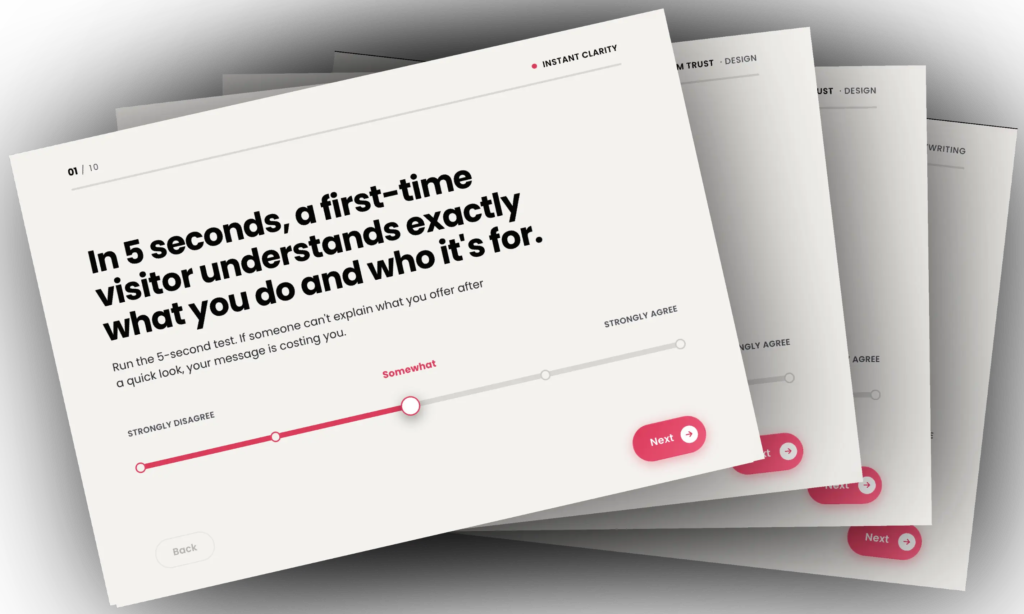
Clear Value Proposition: Within seconds, visitors should understand what you do, who you serve, and why you’re different.
Design Principles That Support Conversion
Clear Visual Hierarchy: Eye-tracking shows users scan in an F-pattern. Place your most important elements (headline, value proposition, call-to-action) where eyes naturally go.
Whitespace: Empty space directs attention and makes key elements stand out. Cluttered designs overwhelm; clean designs convert.
High Contrast CTAs: Your call-to-action button should be impossible to miss.
Mobile-Optimized: With over 60% of traffic from mobile devices, your website must work flawlessly on small screens.
Understanding Visitor Temperature
Not all website visitors are equal. Someone who just discovered you on Google has completely different needs than someone who’s been on your email list for six months.
Understanding visitor temperature, how familiar and ready to buy someone is, changes everything about how you should communicate with them.
Cold visitors don’t know you or trust you. They might have clicked on a Google ad, found you in search results, or followed a social media link. They’re in the discovery phase, learning about their problem and potential solutions.
Warm visitors have engaged with you before. They’ve read blog posts, downloaded content, or received your emails. They know who you are and what you do. They’re in the consideration phase, comparing options and deciding whether to work with you.
Hot visitors are ready to buy. They might have had a consultation with you, received a proposal, or been referred by someone they trust. They’re in the decision phase and just need a smooth path to say yes.
The biggest mistake most websites make is treating all visitors the same, either pushing too hard on cold traffic or moving too slowly with hot traffic.
Brand Positioning: The Foundation Most Businesses Miss
Before worrying about conversion rates or button colors, answer this: Why should someone choose you over every alternative?
This is brand positioning, how you differentiate yourself in your market. It’s not just being “better.” It’s about owning a specific position in prospects’ minds.
Volvo doesn’t claim to be the fastest or most luxurious car. They own “safety.” That’s positioning.
Why Generic Positioning Fails
Visit 100 websites in any industry, and you’ll see the same vague messaging: “Quality service to help your business grow.” This positioning fails because every competitor could say the same thing.
Weak positioning forces you to compete on price. Strong positioning lets you charge premium rates because you’re not comparable to anyone else.
Develop strong positioning by:
- Identifying your ideal client: Get specific about who you’re absolutely best at serving
- Understanding their specific problem: What keeps them up at night? What haven’t they solved?
- Defining your unique solution: How do you solve their problem differently than anyone else?
- Proving it: Case studies and testimonials focused on your specific positioning
How Positioning Affects Conversion
Clear positioning means qualified leads convert faster because they immediately recognize you as the right fit. You attract higher-quality prospects willing to pay for expertise. And you repel wrong-fit prospects, saving time and resources.
Your website should communicate your positioning within five seconds of landing on your home page.
Strategy for Cold and Warm Visitors
Once you understand visitor temperature, you need different strategies for each type. Let’s focus on cold and warm visitors since they represent the majority of your traffic.
Cold Traffic Strategy: Build Trust Before Asking for Commitment
Cold visitors aren’t ready to buy from you. They don’t even know if they can trust you yet. Your conversion goal shouldn’t be a sale or consultation; it should be education and permission to follow up.
What cold visitors need:
- Education about their problem and potential solutions
- Proof that you understand their situation
- Low-commitment ways to engage (free guide, tool, or resource)
- A reason to share their email address
What to avoid: Don’t push for sales calls, demos, or purchases. Aggressive tactics trigger resistance and send cold visitors to your competitors.
Best practices for cold traffic:
- Create educational blog content that addresses common questions
- Offer valuable lead magnets that solve a specific problem
- Use clear, benefit-driven headlines that speak to their pain points
- Include social proof that demonstrates you’ve helped others like them
- Make it easy to learn more without committing to anything
Warm Traffic Strategy: Provide Proof and Remove Objections
Warm visitors already know you. They’re comparing you to alternatives and deciding whether you’re the right choice. Now you can be more direct about what you offer.
What warm visitors need:
- Detailed case studies showing results you’ve achieved
- Testimonials from clients in similar situations
- Clear explanation of your process and what working together looks like
- Answers to specific objections (price, timing, implementation)
- A clear path to the next step (call, demo, proposal)
What to avoid: Don’t make them hunt for information about pricing, process, or next steps. Don’t leave their questions unanswered.
Best practices for warm traffic:
- Create dedicated pages for your services with detailed information
- Showcase specific, measurable results from past clients
- Include video testimonials when possible, they build more trust
- Address common objections directly in your copy
- Make booking a call or requesting a proposal extremely easy
- Use exit-intent popups to capture emails if they’re not quite ready
Segmenting Your Traffic
The most sophisticated websites create different pathways for different temperatures. You might ask on your homepage: “Are you new here?” with paths that segment visitors appropriately.
Use your email nurture sequences to move people from cold to warm by providing consistent value, demonstrating expertise, and building trust over time. Track engagement to understand when someone moves from cold to warm. Someone who’s opened five emails and read three blog posts is warmer than someone who just subscribed.
The One Call-to-Action Rule
Confusion kills conversions. When you present visitors with multiple options, “Contact Us,” “Schedule a Call,” “Download Our Guide,” “Get a Quote” you force them to think about which is right.
When people have to think, they often choose to do nothing.
Each page should have one primary conversion goal that’s crystal clear. Yes, you’ll have navigation menus and footer links, but the visual hierarchy, copy, and design on each page should all point toward one action.
When Multiple CTAs Work
There are strategic exceptions:
Your home page, and your blog/podcast pages: These pages are often the entry point for most visitors, and we clearly don’t know their intent. Therefore, they need multiple calls to action for various pathways based on their intent.
Different visitor temperatures: Cold visitors might need a low-commitment option (free guide) while warm visitors are ready for high-commitment (book a call). But make one clearly primary.
Exit intent popups: If someone’s leaving without converting, offer a lower-commitment alternative to capture their email.
The key is hierarchy. Your primary CTA should be obvious and prominent. Secondary options should be visually less important.
Why Your Website Is Never Finished
The moment you consider your website “complete” is the moment you start losing conversions to competitors who are still optimizing.
Our own website looks completely different today than two years ago, not from a redesign, but from hundreds of small improvements based on real data.
The Optimization Process
Track everything: Use tools like Microsoft Clarity to watch real users navigate your website. Install heat mapping to see where people click and get stuck.
Identify bottlenecks: Where do people drop off? Which pages have high bounce rates? Which forms do people start but never submit?
Test systematically: Change one element at a time, headline, CTA, form length. Measure results before making the next change.
Focus on high-impact areas: Headlines, calls-to-action, form fields, social proof placement, and page length all significantly affect conversion rates.
The Compound Effect
Small improvements compound. A 10% improvement to your headline, another 10% from your CTA, another 10% from your form, and five such improvements result in over 60% total improvement.
That’s not a new website. That’s making your current website work harder through systematic optimization.
Conclusion: Choose Principles Over Trends
Fancy website effects don’t convert. The websites that generate the most leads, sales, and revenue are built on timeless psychological principles, continuously optimized based on real data, and laser-focused on one clear action.
These principles worked before the internet existed. They work today. And they’ll work when the next technology revolution arrives because they’re rooted in how humans think, decide, and act.
Audit Your Current Website
Start by evaluating your website against what you’ve learned:
- Is your positioning immediately clear?
- Do you have one primary call-to-action per page?
- Are fancy effects creating unnecessary confusion?
- Do you have systems to track and optimize continuously?
- Are you treating visitors differently based on their readiness?
If you’re like most business owners, you’ll find significant opportunities for improvement.
Frequently Asked Questions
How often should I redesign my website?
Instead of planning full redesigns every 2-3 years, adopt continuous optimization. Make small, tested improvements monthly. Your website stays current and always improving without the disruption of complete overhauls. That said, if your website is more than 3 years old without updates, it probably needs a refresh to align with current trends and conversion principles.
Can I apply conversion principles without much traffic?
Absolutely, it’s more important when traffic is limited. You can’t afford to waste visitors when you’re getting 100 per month instead of 10,000. Start with fundamentals: clear positioning, one strong call-to-action, benefit-focused copy, and social proof. As traffic grows, layer in sophisticated optimization tools.
What should I look for when hiring a web designer?
Look beyond portfolio aesthetics. Ask about their process for understanding your business and target audience. Request case studies with performance metrics (conversion rates, lead generation, revenue impact). Ensure they plan for post-launch optimization. Ask about their approach to brand positioning and conversion strategy. The right designer asks more questions about your business than about design preferences.
How do I know which conversion principle to focus on first?
Start with your biggest bottleneck. If people aren’t staying on your website, focus on your headline and value proposition. If they’re reading but not converting, examine your call-to-action clarity and placement. If you’re getting form starts but few completions, simplify your forms. Use heat maps and session recordings to see exactly where people get stuck.
Do animations ever make sense?
Yes, but only when they serve a purpose. Subtle animations that guide attention (gentle pulse on a CTA) or provide feedback (loading indicators) can improve user experience. Animations should enhance clarity and usability, not just look cool. If you can’t articulate how an animation helps conversions, it’s probably hurting them.
Ready to Transform Your Website’s Performance?
At Studio1 Design, we’ve spent over 20 years perfecting conversion-focused web design. We’ve designed over 2,000 websites and continuously improve performance through our Conversion Optimization process.
We’re not interested in building you a pretty website. We’re interested in building you a website that turns visitors into customers 24/7.
Book a free strategy call and we’ll analyze your current website, identify your biggest conversion opportunities, and show you exactly how we’d improve your results. No obligation, no pressure, just actionable insights you can use whether you work with us or not.
Your future customers are already visiting your website. The only question is whether you’re converting them or losing them to competitors who understand these principles better.