Key Takeaways
- Most visitors aren’t ready to buy when they land on your website
- Your website might look great… but still be leaking leads and sales due to poor conversion design
- More traffic won’t help if your website isn’t optimized for conversions
- Small, strategic website changes can significantly increase leads and sales
- Why interactive lead magnets outperform traditional PDFs that can sit there unopened.

Studio1’s founder, Greg Merrilees, was interviewed by Jeremy Rivera here on the Unscripted SEO podcast to talk through what we’ve observed across more than 2,000 website projects. Topics ranged from visitor intent and lead magnets to why chasing design trends tends to hurt conversions, and what the rise of AI-generated content means for brands trying to stand out.
This post captures the key ideas from that conversation, and by the end, you’ll have a clearer sense of what a conversion-focused website actually looks like and what tends to get in the way.
Most business owners know their website should “convert better.” But what does that actually mean in practice?
The difference between a website that generates leads and one that doesn’t often comes down to a few structural decisions, how you handle different types of visitors, how clearly you say what you do, and whether your lead generation approach still matches how people behave today.
Do You Even Need a Website Anymore?
“Why do we even need websites? We’ve got social media now, so do I really have to bother with building a whole website?” – Jeremy Rivera

If you’re just starting out, you might get by with social media and a basic presence. But if you’ve been in business for years, built a brand, earned referrals, and developed SEO equity, your website is a core business asset.
Social media is rented land. Algorithms change. Platforms shift. Accounts get restricted. Everything you build there can be taken away. A website is yours. Paired with lead magnets and an email list, it becomes the foundation of a marketing ecosystem you actually control, one that keeps working even when you’re not actively posting.
If you’re just starting out, you might get by with social media and a basic presence. But if you’ve been in business for years, built a brand, earned referrals, and developed SEO equity, your website is a core business asset.
Social media is rented land. Algorithms change. Platforms shift. Accounts get restricted. Everything you build there can be taken away. A website is yours. Paired with lead magnets and an email list, it becomes the foundation of a marketing ecosystem you actually control, one that keeps working even when you’re not actively posting.
There’s also a newer reason to take your website seriously. AI tools like ChatGPT are actively reading websites to form answers about businesses. As Jeremy Rivera put it during our conversation: “ChatGPT is your least trained but most popular customer support representative, and it’s checking your website.” If your website has thin or no content, you’re giving those systems very little to work with.
SEO isn’t dead. The fundamentals, putting useful, clear content on your own website, still hold. If anything, the case for maintaining a strong website has grown.
Understanding Visitor Intent: Cold, Warm, and Hot
“What do you bring to the table in that analysis when you’re discussing building out a website for a new company?” – Jeremy Rivera

One of the most common conversion mistakes we see is treating all visitors the same.
The reality is that 97% of people who land on your website aren’t ready to buy. They’re researching, exploring, and figuring out whether you’re even relevant to them. Pushing a sales message at that moment is a bit like proposing on a first date.
Intent is everything. Which page did a visitor arrive on? Was it a blog post, a landing page, a product page? What are they likely there to do? The most logical next step will differ for each visitor, and your website needs to account for that.
We think about visitor intent in three broad buckets.
Cold Traffic
Cold visitors are encountering your brand for the first time. They don’t know you, they’re not ready to commit, and they’re almost certainly not going to book a call or buy something today.
What they will do is accept something genuinely useful in exchange for an email address. A good lead magnet, something that solves a specific problem or gives them a useful result, is the right offer here. The goal isn’t the sale. It’s the relationship.
On blog pages, for example, we often place a sticky lead magnet offer in the sidebar alongside the content. That way, as someone reads through your material, the next step is right there when they’re ready.
Warm Traffic
Warm visitors have had some contact with your brand before. They’ve read your content, followed you on social media, or been referred by someone who knows you. They trust you a little more.
For this group, you can offer something that asks for more of their time, a free video series, a challenge, a more in-depth resource. The more they invest, the more trust is built. And the more trust builds, the more likely they are to take action when they’re ready.
Hot Traffic
Hot visitors already know what they want. They’re ready to take the next step, they just need a clear path to do it.
Don’t run them through a funnel designed for cold visitors. Give them a dedicated page with one clear action and no distractions. Strip the navigation. Remove the options. Just give them the thing they came for.
The home page isn’t usually the right place for this. It needs to serve all three types of visitors. But a purpose-built booking or sales page can and should be built specifically for hot leads.
Why Copywriting Matters More Than Design
“What is it about the sales mentality that is so opposed to literally saying what it is that you do?” – Jeremy Rivera

This might sound strange coming from a design agency. But the most important element on any website is the copywriting.
Design matters. A poorly designed website can undermine even great copy. But the words are the foundation. If someone lands on your page and can’t quickly understand what you do, who it’s for, and why it matters to them, they’ll leave. A beautiful layout won’t change that.
Here’s a quick test you can run right now. Count how many times “I” or “we” appear on your website versus “you” or “your.” If the ratio skews toward you and your business, the copy is oriented the wrong way. It should feel like it’s talking to the visitor, about their problem, their situation, their next step.
Donald Miller’s Building a StoryBrand frames this well. Your customer is the hero. You’re the guide. Every line of copy should reflect that framing. Your headline shouldn’t say “We are a full-service law firm.” It should say something like: “If you’ve been injured and the insurance company is lowballing you, we can help.” One of those lines speaks to the visitor. The other is about you.
What’s Wrong With Chasing Design Trends
“What is the du jour of web design right now? What are people saying ‘my website needs to be able to do this’ about?” – Jeremy Rivera

Every year there are new visual trends in web design. Parallax effects. Immersive animations. Video backgrounds. Things flying in as you scroll.
Most of them don’t help conversions. In many cases, they hurt.
Design trends tend to originate because designers get bored, not because they improve outcomes. Parallax effects, animation-heavy layouts, and video hero backgrounds all share a common problem: they pull the visitor’s attention away from the words.
Video backgrounds are a particularly common conversion issue. They slow page load. They distract from the copy. And if a returning visitor sees the same loop playing again, it feels stale rather than impressive.
A restrained design with strong copy will typically outperform a visually striking one. The goal isn’t to win a design award. It’s to make it easy for the right person to take the next step.
The AI Sameness Problem
“Let’s break out the soapbox. What’s been something you’re passionate about that you want to get off your chest?” – Jeremy Rivera

AI-generated websites and copy tend to look and sound the same. Stanford University research found that major language models returned remarkably similar answers even when prompted to be diverse and creative. Same structures. Same patterns. Same references.
One pattern is easy to spot once you know it: the “it’s not this, it’s not this, but it’s that” construction. It appears constantly in AI-generated video scripts and emails. Once you notice it, you’ll see it everywhere.
The consequence for websites is real. If your website is built using the same tools and prompts as everyone in your category, it’s going to look and feel like theirs. That’s not differentiation, it’s noise at scale.
Google has also been increasing its emphasis on genuine brand signals, branded anchor text, third-party references, and the kind of consistency that indicates a real business with a real identity. Generic AI output doesn’t generate those signals naturally.
The businesses that hold their own will invest in genuine brand strategy: distinct visual identity, clear positioning, and copy that reflects how real people in your business actually think and talk.
How to Stand Out in a Commoditized Market
“How do you approach making those unique? What do you focus on in that creation process to draw something unique out of them?” – Jeremy Rivera
This is one of the hardest problems for businesses in crowded categories. Lawyers, realtors, accountants, coaches, consultants, many offer similar services and struggle to articulate what makes them different.
Most businesses don’t know what makes them unique!
Generic claims like “we’re the best” or “we’ve got great customer service” don’t do the work. Everyone says that. It’s noise.
The better approach is to mine your reviews and testimonials for recurring themes. What do clients say about you again and again? Not what you think is special about your business, what do your clients actually say? Paste your testimonials into ChatGPT and ask it to find the patterns. You’ll often discover differentiators you weren’t consciously aware of.
From there, build case studies that tell real stories. Not just numbers, narratives. Here’s what this person was facing. Here’s what changed. Here’s what the outcome looked like for them. That kind of storytelling gives prospective clients a way to see themselves in the story, which is far more compelling than a headline statistic alone.
Individual case studies are one of the most underused tools in professional services marketing. Most businesses post a summary number but never tell the story behind a single case. The story is what builds connection.
Why Interactive Lead Magnets Are Replacing PDFs
“Tell me what lead magnets are in this day and age?” – Jeremy Rivera

PDFs still work, but they’re not doing the work they used to. People know what happens when they download one. It goes into a folder. They mean to read it. They usually don’t.
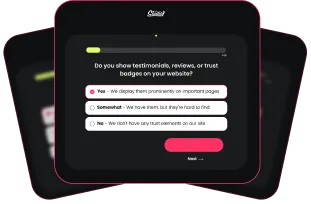
What works better now is the interactive lead magnet, a tool that asks a few questions and gives someone an instant, personalized result. A score. A calculation. A recommendation based on their specific situation.
We built a macro calculator for Enterprise Fitness, a personal training business. Visitors entered their details and immediately got a breakdown of their daily macros to hit their goals. That tool outperformed their PDF downloads significantly, because it gave people something useful right away, with no waiting and no reading required.
The technology to build these has changed dramatically. Tools that would have required a dedicated developer a few years ago can now be built faster and more affordably. For businesses looking to improve lead capture, interactive tools are worth exploring alongside, or instead of, static resources.
Frequently Asked Questions
Q: How do I know if my website’s problem is the copy or the design?
A: A useful test is to read your words without the visuals. Do they clearly explain what you do, who it’s for, and what the visitor should do next? If the copy doesn’t hold up on its own, that’s often where the work needs to start. Copy and design need to work together, but copy tends to be the higher-leverage starting point.
Q: What makes a lead magnet effective today?
A: The most effective lead magnets give people a quick, specific result they can act on immediately. Interactive tools, calculators, scorecards, assessments, tend to perform well because they feel personalized and deliver value instantly. PDFs can still work, but they need to solve a very specific problem for a very specific person. Generic checklists and ebooks rarely move the needle the way they once did.
Q: How do I find out what’s making visitors leave my website?
A: Microsoft Clarity (free) provides heatmaps and session recordings that show where visitors click, how far they scroll, and where they leave. Paired with Google Analytics to see traffic sources and exit pages, you can form testable hypotheses about what’s causing drop-off, then A/B test changes or compare performance over time if your traffic volume is lower.
Q: Should I build on WordPress, Webflow, or something else?
A: Platform choice matters less than strategy. A well-structured website on any major platform will outperform a poorly structured one on a “better” platform. The most important question isn’t which platform, it’s whether the website is designed around your visitors’ needs and the actions you want them to take.
A website that converts isn’t about having the latest design features or the most impressive animations. It’s about understanding who’s visiting, meeting them where they are, and making it easy for them to take the next logical step.
The principles that come up again and again across thousands of projects tend to be the same: clarity in what you say, structure in how you present it, and genuine value in what you offer. Those things don’t change much regardless of what’s happening with technology or trends.
If you’re wondering how these ideas might apply to your specific situation, we’re happy to take a look. We offer a no-pressure strategy conversation to talk through what’s working, what isn’t, and what options are available. No pitch, just an honest conversation.