Key Takeaways
- Your website is now middle of funnel. By the time someone lands on your site, they’re already evaluating you against competitors.
- Vibe-coded sites look and sound the same. When everyone uses the same AI tools, price becomes your only differentiator.
- A website is a system, not a finished project. 97% of visitors aren’t ready to buy on their first visit — without a funnel, they’re gone forever.
Vibe coding has made it faster and cheaper than ever to launch a website. Prompt an AI tool, tweak the output, hit publish, and you have something that looks professional in a day.
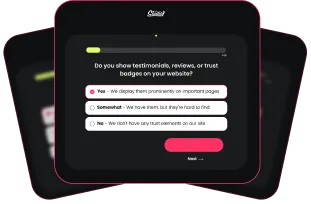
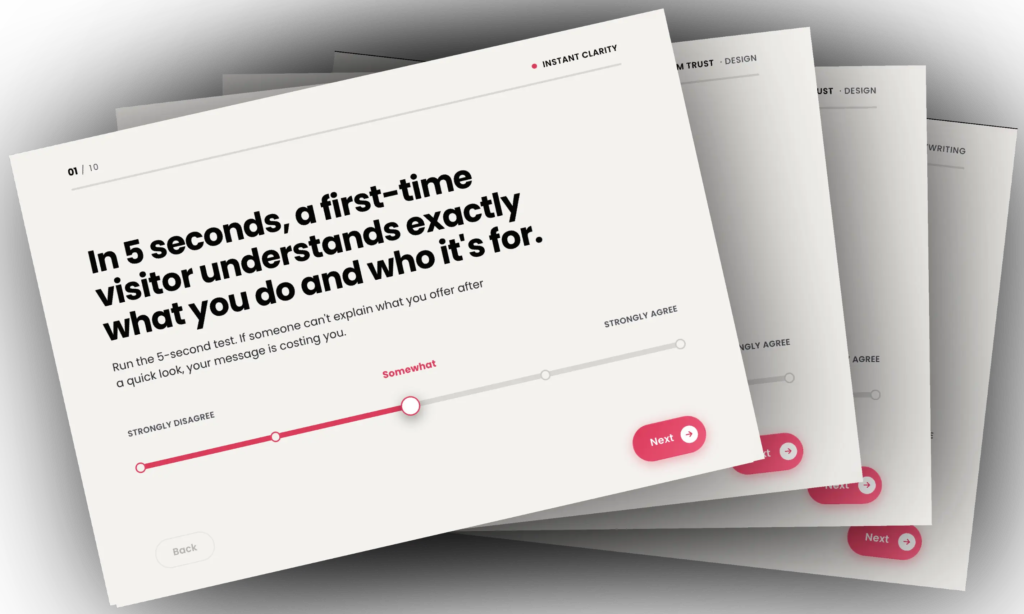
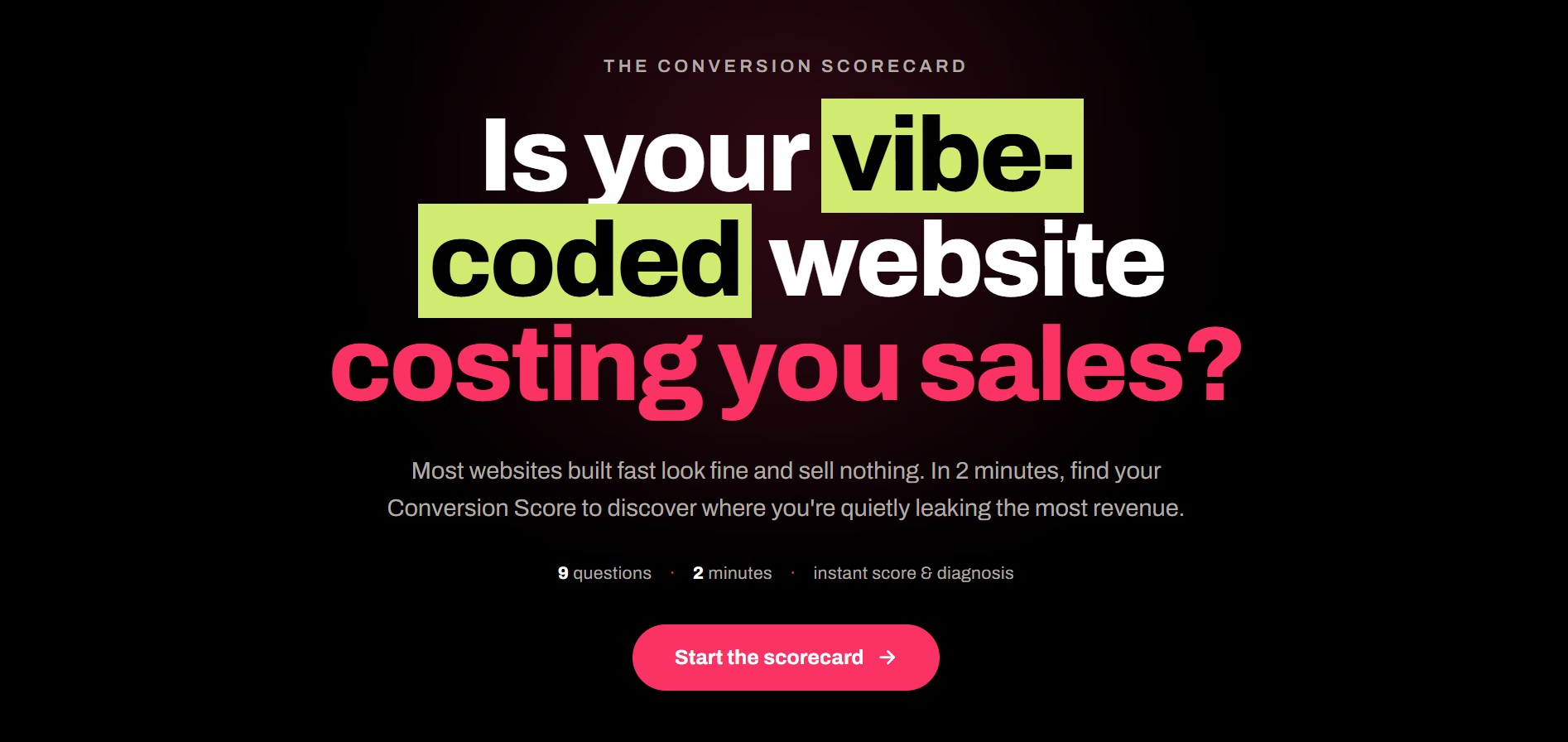
But speed and aesthetics are not the same as performance. And for most businesses, the gap between the two is quietly costing them leads. Not sure if your website has a performance gap? Take the free scorecard
This post isn’t about whether vibe-coded websites look good. Many of them do. It’s about whether they’re working, and the specific conversion fundamentals that AI-generated sites almost always leave out.
Use this as a diagnostic. If your website was built primarily with AI tools and you’re not getting the leads or inquiries you expect, work through each section and assess honestly where the gaps are.
Why Your Website’s Job Has Changed
Until recently, most people discovered businesses through Google search. Your website sat at the top of that funnel and was often the first point of contact with a potential client.
That’s changed.
A growing proportion of buying journeys now begin in AI tools like ChatGPT, Perplexity, and Google’s AI Overviews. People ask these tools for recommendations, get curated answers, and then visit the websites of the businesses that come up.
This means your website is increasingly operating as a middle-of-funnel asset, not a top-of-funnel one. Visitors arriving on your site have often already done a first pass. They’re not discovering you. They’re evaluating you and comparing you against alternatives they’ve already been shown.
That’s actually an opportunity. Warm traffic converts at a higher rate than cold traffic. But only if your website is built to build trust quickly, communicate your value clearly, and give visitors a path that matches where they are in their decision.
Most vibe-coded websites aren’t built for that job.
The 7-Point Vibe-Coded Website Audit
1. Brand Positioning: Does Your Site Communicate Why You, Specifically?
The first question every visitor is unconsciously asking is: “Is this the right business for me?”
Brand positioning answers that question. It’s not your logo, color scheme, or tagline. It’s the perception your website creates: that this business understands my situation, operates at the level I expect, and offers something I won’t find somewhere else.
Vibe-coded websites routinely fail this test. Because AI tools are trained on vast amounts of existing web content, they produce output that resembles the average of what’s already out there. The resulting sites look credible but feel generic.
What strong brand positioning looks like in practice:
- A clear articulation of who specifically you serve, not just what you do
- A unique value proposition that reflects something genuinely distinctive about your approach or results
- Design choices that feel specific to your brand rather than pulled from a template
- Positioning that makes your ideal client feel seen, not just informed
Audit question: If you removed your logo and contact details, could a visitor tell your business apart from your three closest competitors? If the honest answer is no, your positioning work isn’t done.
2. Differentiation: Does Your Website Stand Out Visually and Strategically?
Differentiation is about whether your website looks and feels different from others in your market, and whether it communicates a strategic advantage competitors can’t easily copy.
When multiple businesses in the same niche use the same AI tools with similar prompts, they end up with near-identical page structures, similar stock image styles, and interchangeable copy. When your website looks like your competitors’ websites, you’ve made price the primary differentiator by default.
Differentiation operates at two levels:
Visual differentiation: Custom photography over stock images. Typography and color choices that feel deliberate and brand-specific. Design that signals the caliber and personality of your business before a word is read.
Strategic differentiation: What you claim on the page, and whether those claims are specific enough to be believed. Vague promises (“we deliver exceptional results”) are indistinguishable from competitor claims. Specific, verifiable differentiators (“we’ve built over 2,000 websites and run conversion optimization tests across 12 rounds for a single client”) are not.
Audit question: When did you last look at your three closest competitors’ websites side by side with yours? Do you see meaningful differences in design, messaging, and claimed value, or do they all read from the same template?
3. Persuasive Copywriting: Does Your Copy Move People, or Just Describe You?
This is the most common and most costly failure in vibe-coded websites.
AI-generated copy tends to be grammatically correct, professionally structured, and completely unconvincing. It describes. It doesn’t persuade. It tells people what you do without giving them a reason to care or a reason to choose you.
The copy on a conversion-focused website answers three questions every visitor is silently carrying:
- What do you do, and what does that mean for me?
- Who are you, and why should I trust you?
- Why you over everyone else?
Effective copy also speaks in the language of your visitor’s actual pain, using the words your clients use to describe their problems and the outcomes they’re hoping for, not the language you use internally to describe your services.
AI can produce words. It can’t produce empathy without the strategic direction that comes from real market research.
Audit question: Read your home page out loud. Does it sound like it was written by someone who deeply understands your client’s situation, or does it sound like a professional-sounding description of a business? There’s a significant difference.
4. Visitor Pathways: Does Your Website Serve Cold, Warm, and Hot Visitors Differently?
Not every visitor who lands on your website is in the same place.
Cold visitors are encountering your brand for the first time. They don’t know you, don’t yet trust you, and aren’t ready to buy. Sending them straight to a “Contact Us” page is what Greg Merrilees calls “selling on hello,” and it rarely works. These visitors need clarity, value, and a low-commitment first step.
Warm visitors have had some prior exposure to your brand. They have some trust already built but need to deepen it through case studies, testimonials, and content that demonstrates your expertise in their specific situation.
Hot visitors are ready to move forward. They need a clear, frictionless path to take action. For hot visitors, friction is the enemy.
A vibe-coded website typically offers one experience to all three audiences, either confusing cold visitors with a premature sales push, boring hot visitors with unnecessary nurture content, or failing warm visitors by not giving them the deeper proof they need.
Audit question: Does your website have a clear, valuable first step for a visitor who’s never heard of you? Does it have a clear, direct path for someone who’s already warm and ready to inquire? If either pathway is missing, you’re losing leads at both ends.
See how your website scores across all seven areas: Studio1Design.com/scorecard
5. Lead Magnets and Funnel Strategy: Are You Capturing the 97%?
Approximately 97% of website visitors are not ready to buy on their first visit. If your website’s only call to action is a direct inquiry or purchase, you are effectively ignoring 97% of your traffic.
A lead magnet solves this. It’s a free, high-value resource, such as a guide, checklist, scorecard, or free audit, that gives a cold visitor something genuinely useful in exchange for their contact details. It starts a relationship, earns permission to stay in touch, and begins a nurture sequence that moves people from cold to warm to hot on your timeline.
The best lead magnets do three things simultaneously:
- Deliver immediate, standalone value
- Demonstrate your expertise in the specific problem your paid offer solves
- Create a natural bridge to the next step in your funnel
Vibe-coded websites are built as pages. A website with a lead magnet strategy is built as a system. The difference in long-term lead generation between the two is not marginal.
Audit question: What happens to a visitor who lands on your website, finds it interesting, but isn’t ready to engage right now? Do they have a reason to give you their contact details? If the answer is no, you’re leaving most of your traffic with no path back to you.
6. GEO, Generative Engine Optimization: Is Your Website Visible to AI Search?
Traditional SEO optimized websites to rank in Google’s ten blue links. That model is being disrupted.
When someone asks ChatGPT, Perplexity, or Google’s AI Overview a question in your category, those tools don’t return a list of links. They synthesize an answer and cite sources they judge to be authoritative and clearly structured.
Generative Engine Optimization (GEO) is the discipline of structuring your website so that AI systems can read, parse, and cite it accurately. It differs from traditional SEO in several key ways:
- Topical authority over keyword density. LLMs reward depth and expertise, not keyword repetition.
- Clear structure for machine parsing. Proper heading hierarchy, FAQ-style content blocks, and explicit definitions help LLMs extract and surface your content accurately.
- Named entities and specificity. AI tools are better at citing businesses that are specific: named clients, verifiable results, named methodologies.
- Schema markup and structured data. Technical signals that help AI tools understand what your content is about and who it’s relevant to.
A vibe-coded website built for aesthetic appeal, with flat structure and generic copy, is largely invisible to AI search.
Audit question: If someone asked ChatGPT or Perplexity for a recommendation in your category and location, would your business come up?
7. Conversion Optimization: Is Your Website Getting Better Over Time?
The businesses that compound their results online treat their website as a system to be continuously improved, not a project to be completed.
Conversion Rate Optimization (CRO) is the process of using real data, such as heatmaps, session recordings, analytics, and split tests, to identify where visitors are dropping off, form hypotheses about why, design improvements, and test them against the original.
The compounding effect is significant. At Studio1, we worked with Enterprise Fitness through 12 rounds of systematic testing on a single website. By the end:
- Consultation bookings increased by 64%
- Mobile conversions doubled from 3.13% to 6.10%
- Average time on site doubled from 1:45 to 3:30
- Bounce rate decreased by 38%
None of those results came from a single dramatic change. They came from a series of incremental improvements, each building on the last.
Curious how your website measures up? Get your free score
Audit question: When did you last look at how visitors are actually behaving on your website? Do you know which pages have the highest exit rates? Which CTAs are being ignored? If you don’t have answers to those questions, your optimization work hasn’t started yet.
Where AI Fits, and Where It Doesn’t
Using AI in website development is not the problem. At Studio1, we use AI tools to accelerate our process, exploring options faster and delivering more efficiently for our clients.
The problem is using AI as a replacement for strategy rather than a tool within it.
AI can generate a layout. It cannot determine the right positioning for your business in your specific market. It can write copy. It cannot write copy that resonates with your audience’s pain points without deep research into who those people are. It can produce a functional website. It cannot build a conversion-optimized system without the strategic thinking that defines what “converting” actually means for your business goals.
The businesses that win with AI-assisted website development bring the strategy first and use AI to execute it faster. The ones that use AI to replace the strategy end up with websites that look like everyone else’s and perform like everyone else’s too.
Frequently Asked Questions
What is a vibe-coded website? A vibe-coded website is one built primarily using AI tools, typically AI website builders or coding assistants, with minimal strategic input around conversion, brand positioning, or marketing funnel design.
Can a vibe-coded website convert visitors into leads? Some do, typically when the business already has strong brand recognition or warm referral traffic. But for most businesses relying on their website to generate cold or semi-warm leads, the absence of conversion strategy and structured visitor pathways means they’re leaving a significant proportion of potential inquiries unrealized.
What’s the difference between SEO and GEO? Traditional SEO focuses on ranking in Google’s organic results through keyword targeting, backlinks, and technical site health. GEO (Generative Engine Optimization) is about structuring your website so that AI-powered search tools like ChatGPT, Perplexity, and Google’s AI Overviews understand, trust, and cite your content when answering relevant queries.
How do I know if my website is actually converting? Divide the number of visitors who take a desired action by total visitors to get your conversion rate. Tools like Google Analytics 4, Hotjar, and Microsoft Clarity give you behavioral data to identify why your conversion rate is what it is. Here are some diagnostic tools for your website.
What should I do first if my website isn’t converting? Start with diagnosis before solutions. Run the seven-point audit above, install behavioral tracking tools, and identify your single biggest gap. Most businesses find that fixing visitor pathways and adding a lead magnet delivers the fastest measurable improvement.
Find Out Exactly Where Your Website Stands
Our free scorecard, “Is Your Vibe-Coded Website Costing You Sales?”, walks you through each of these areas and gives you a score so you can see exactly where your website is strong and where the gaps are costing you leads.
It takes a few minutes, and at the end you’ll have a clear picture of what to prioritize.